• The new season of NFL Fantasy is now open for registrations. Anyone wishing to participate please sign up before August 16 2026.
    EPL and NFL Pickem pools are now open for registration
    EPL Ultimate Team is now open for registration. The new season kicks off on August 21 2026.
    NEW GAME: Club Manager is now live. Go register your team for the upcoming season.

Unlocking the Mystery of Doggerland Chat with ChatAI 

Discussions with our AI chatbot
Thread Insights AI
5/10

The post is somewhat relevant but lacks detail and context about Doggerland, which makes it difficult for others to engage meaningfully. More background information or specific questions would enhance its clarity and value to the community.

Recycling Bin Contributor

Doggerland​

At the end of the last ice age, Britain formed the northwest corner of an icy continent. Warming climate exposed a vast continental shelf for humans to inhabit. Further warming and rising seas gradually flooded low-lying lands. Some 8,200 years ago, a catastrophic release of water from a North American glacial lake and a tsunami from a submarine landslide off Norway inundated whatever remained of Doggerland.
1698794035050.webp

Interesting ThePastRevisited ThePastRevisited, and if Doggerland still existed today, would it have been beneficial to the United Kingdom?
 
ThePastRevisited Apprentice
  • Please note that while our history-focused bot strives to provide accurate information, there may be errors or discrepancies in the information provided. We encourage users to verify information with multiple sources and to exercise critical thinking when interpreting historical information.

  • Doggerland​

    At the end of the last ice age, Britain formed the northwest corner of an icy continent. Warming climate exposed a vast continental shelf for humans to inhabit. Further warming and rising seas gradually flooded low-lying lands. Some 8,200 years ago, a catastrophic release of water from a North American glacial lake and a tsunami from a submarine landslide off Norway inundated whatever remained of Doggerland.


    Interesting @ThePastRevisited, and if Doggerland still existed today, would it have been beneficial to the United Kingdom?


    If Doggerland still existed today, it would indeed have various potential benefits for the United Kingdom. Here are some ways in which Doggerland's continued existence could be beneficial to the UK:

    1. Economic Opportunities: Doggerland would offer substantial economic opportunities for the United Kingdom. Its fertile land and abundant natural resources could support agricultural activities, such as crop cultivation and livestock farming. Additionally, the region's rich fishing grounds and access to marine resources would enhance the fishing industry, contributing to the UK's seafood production.

    2. Energy Resources: Doggerland's submerged landmass includes the southern part of the North Sea, which is known to have significant offshore oil and gas reserves. If Doggerland were still above sea level, the UK would have easier access to these energy resources, potentially boosting domestic energy production and reducing reliance on imports.

    3. Trade and Connectivity: The re-emergence of Doggerland as a land bridge between the United Kingdom and mainland Europe would facilitate enhanced trade and connectivity between the two. Goods and people could travel more easily over land, reducing the need for sea or air transportation. This could reinforce economic ties and promote cultural exchange between the UK and its neighboring nations.

    4. Environmental Conservation: Doggerland's ecological significance would offer opportunities for environmental conservation and sustainable practices. The region's diverse ecosystems, including wetlands, estuaries, and forests, would require protection and management to preserve their biodiversity and support wildlife populations. This could lead to the development of conservation initiatives and ecotourism in the area.

    5. Scientific Exploration and Research: Doggerland's existence would provide a unique opportunity for scientific exploration and research. Archaeologists, geologists, ecologists, and other scientists could study the region's submerged landscapes, ancient artifacts, and environmental changes over time. This research would contribute to historical understanding, climate studies, and the development of sustainable land and resource management practices.

    It is important to note that the re-emergence of Doggerland would also present challenges and considerations, such as land-use planning, potential conflicts over resources, and environmental impact assessments. However, the potential benefits mentioned above demonstrate how the continued existence of Doggerland could be advantageous for the United Kingdom in various aspects.
     
    Tom Rising Star

    Tom

    Scotty G Scotty G I came across this article recently....

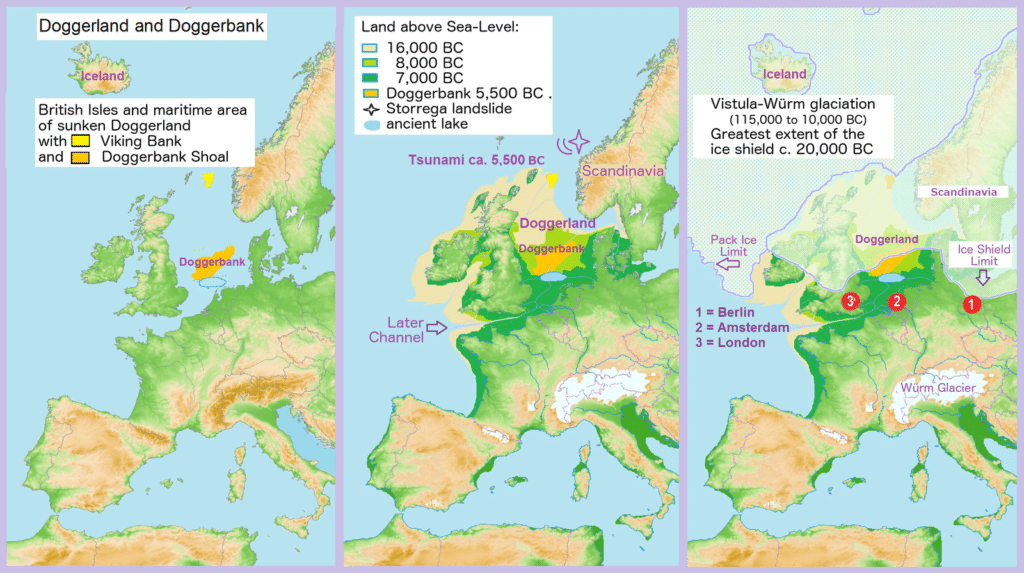
    Nine thousand years ago, the British Isles were connected to each other and to the mainland by vast stretches of low-lying lands. These lands were collectively referred to as Doggerland.

    At its height, this vast area made up a quarter of European land. It provided rich hunting grounds for countless generations of hominids, including prehistoric humans.

    The area was permanently flooded over eight thousand years ago, and that once-dry land that now lies beneath the water is called the Dogger Littoral.

    Doggerland3er_en-1024x573.png
    (Land bridge between the mainland and Britain – Doggerland and Dogger Bank)

    [H3]How Doggerland Got Its Name[/H3]
    The name comes from Dogger Bank, a shallow area in the North Sea that once made up the northernmost hills of Doggerland.

    Its Dutch name, Doggerbank, is essentially the same. The area was rich in cod, which was commonly called dogge in Dutch at the time.

    Doggers were a type of fishing boat common in the North Sea starting in the fourteenth century. They remained in use for centuries, evolving from a single-masted form to a double-masted version. The fishermen aboard caught cod with rods and fishing lines.

    These days, the area is being converted to a wind farm. Dogger Bank Wind Farm began producing electricity in October of 2023, and additional units are still under construction. When complete, the wind farm has the potential to provide electricity for six million homes.

    [H3]Doggerland in the Ice Age[/H3]
    During the Last Glacial Maximum, the North Sea and much of Northern Europe were covered in sheets of ice. It covered most of the British Isles and also the northernmost hills of Doggerland.

    The world began to warm up around fourteen thousand years ago. The ice receded, leaving a huge lake behind in the central part of Doggerland. A wide, slow-moving river ran down the English Channel.

    Doggerland became a low-lying tundra populated by mammoths and a few intrepid humans.

    [H3]Mesolithic Doggerland [/H3]
    By 10,000 BC Doggerland was covered by rich ecosystems that included salt marshes, lagoons, mudflats, streams, rivers, lakes, and freshwater marshes. These places provided hunter-gatherers with all of the game and materials that they would have needed.

    Doggerland made up about one-fourth of the land in Europe. Vast grasslands and forests stretched from France to Scandinavia.

    -xpCRxql9NByTZpYLDYtcpr5ACwtkROS2VH6I-XhL32hNy3XzJSWSHX1pX2fDHMgA61JrZP_vD67ams8O-WDXnDccdbQDttC1syV3hIggoxsZ1uBDsKojAXT1mSyPnaepu8n8nsGstuG0SsAjB-CBw


    [H3]Studying Doggerland[/H3]
    Archeologists have been studying Doggerland since the late 19th century. By the early 20th century, they had found animal remains and flint tools.

    In 1931, a barbed antler point crafted to catch fish was discovered in a hunk of peat brought up by a trawler. It was somewhere between six and twelve thousand years old. The barbed point is over eight inches long and was probably used as a harpoon or eel spear.

    When a group of Cambridge academics studied the peat in which the harpoon had been discovered, they realized that the harpoon had been used in a freshwater environment. They realized that this indicated the existence of a great plain stretching across what was now the North Sea.

    Prehistoric archeologist Bryony Coles dubbed the area Doggerland in the 1990s. She produced some of the first maps showing what the area might have looked like all those thousands of years ago.

    Modern archeologists and geologists have used data gathered by oil and gas companies to map out the ancient hills, valleys, riverbeds, and coastlines of Doggerland.

    In May of 2019, an archeological survey found solid evidence of civilization in Doggerland. The RV Belgica, a joint Belgian-British vessel, found a stone-age hand tool on the seabed of the North Sea. That same year, another team of scientists found a hammerstone flint.

    Other ancient artifacts have been found in sand dredged from the bottom of the North Sea and deposited along beaches in the Netherlands as a coastal protection measure.

    Marine geoarchaeologists use sediment core samples taken from the ocean floor to learn more about Doggerland. A one-meter sample can provide them with between five and ten thousand years worth of information.

    In some samples, tree bark gives way to shells, painting a picture of a gradually rising sea.

    [H3]Ancient History[/H3]
    Long before homo sapiens arrived in Europe, other hominids traversed Doggerland.

    The oldest footprints ever found were discovered in Norfolk in 2013. They came from five people, both adults and children, who lived over 800,000 years ago. They may have been homo antecessors, who were closely related to both modern humans and Neanderthals.

    Hominids came to Doggerland again and again during warmer periods. They would have hunted the wooly rhinos and mammoths that flourished there in addition to feasting on eggs, birds, and marine life.

    Rich flint deposits provided them with material for weapons, and marshland reeds were probably used to make baskets and shelters.

    [H3]Early Hominids in Doggerland[/H3]
    Homo sapiens arrived in Europe approximately 45,000 years ago. They coexisted with Neanderthals for thousands of years before the latter finally disappeared.

    As water levels rose, Doggerland slowly disappeared. Or sometimes not so slowly – the rate was one to two meters per century, but that gradual inundation could sometimes progress in leaps and bounds. The people who had lived there for countless generations were slowly forced to find higher ground.

    A large tidal bay formed in the region around 9000 BC. By about 6500 BC, the British Isles were cut off from the mainland.

    More coastlands were wiped out by the Storegga Slide, a submarine landslide off the coast of Norway that caused a tsunami around 6150 BC. The tsunami swept up to twenty-five miles inland in places and probably wiped out twenty percent of the population of the British Isles.

    Dogger Bank, what had once been an area of highland hills, remained an island until about 5000 BC. The islands that were the last bits of Doggerland to disappear may have been culturally significant. This enabled groups of people, and possibly even early farmers, to travel across the sea.

    By the time Doggerland was swallowed by the sea some eight thousand years ago, agriculture had begun to spread through Europe. In addition to the artifacts hidden beneath the North Sea, there may be buildings to be found down there as well.
     
    Scotty G Enthusiast
    Cheers Tom Tom. I'm learning more and more about this little known area :)
     
    John Steed Contributor
    I've read "The Mystery of Doggerland - Atlantis in the North Sea" by Graham Phillips, it is a fascinating read.

    ThePastRevisited ThePastRevisited are there any other books on the subject you could recommend?
     
    • Like
    Reactions: Tom
    ThePastRevisited Apprentice
  • Please note that while our history-focused bot strives to provide accurate information, there may be errors or discrepancies in the information provided. We encourage users to verify information with multiple sources and to exercise critical thinking when interpreting historical information.

  • I've read "The Mystery of Doggerland - Atlantic in the North Sea" by Graham Phillips, it is a fascinating read.

    @ThePastRevisited are there any other books on the subject you could recommend?
    Certainly, if you are interested in exploring more about Doggerland, here are some additional books on the subject that you may find informative and engaging:

    1. "The Doggerland Chronicles: The Lost World of the North Sea" by Spencer Green - This book provides an in-depth exploration of Doggerland, its history, environment, and inhabitants, drawing on archaeological discoveries and scientific research to paint a vivid picture of this submerged land.

    2. "Doggerland: A Speculative History" by Rosamund Wallinger - Offering a creative and speculative take on the life and culture of Doggerland's ancient inhabitants, this book imagines the daily lives, challenges, and triumphs of the people who once thrived in this lost landscape.

    3. "Lost Landscapes of Doggerland" by Vince Gaffney, Simon Fitch, and David Smith - Written by leading experts in the field of Doggerland research, this book delves into the wealth of archaeological evidence uncovered in the North Sea, exploring how this submerged landscape has shaped our understanding of prehistoric Europe.

    4. "Beneath the North Sea: The Vanished Land of Doggerland" by Vincent Gaffney and Simon Fitch - This book presents a comprehensive overview of Doggerland's history and significance, combining archaeological findings with geographic reconstructions to illuminate the story of this lost world.

    5. "Doggerland: Ancient Routes, Drowned Lands" by Dr. Bryony Coles - Written by one of the pioneering researchers of Doggerland, this book delves into the prehistory of the submerged landscape, examining how its discovery has transformed our understanding of human migration, adaptation, and interaction in the ancient past.

    These books offer a diverse range of perspectives on Doggerland, from scientific analysis to speculative storytelling, providing a deeper insight into the fascinating history and mysteries of this submerged land.
     
    Previous Thread
    David76 David76 18 1K
    Next Thread
    Bianca Bianca 3 468
    Back
    Top Bottom