

The Universe: Space Exploration Discussion Thread General Chat 

Thread Insights Discussion AI
Exploring the cosmos reveals astonishing discoveries.
7/10 Informational

The post presents an interesting fact about galaxies and provides a relatable analogy, enhancing community engagement. However, it could benefit from deeper insights or questions to stimulate discussion.

James Webb Telescope NASA discoveries galaxies habitable planets solar system

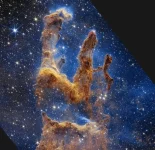
The thread begins with a focus on the vastness of the universe, featuring Hubble's images showcasing dense galaxies and discussions about the immense number of habitable planets within the Milky Way and beyond. Contributions highlight the cutting-edge findings from the James Webb Space Telescope, illustrating incredible structures like the Pillars of Creation.12

As the conversation progresses, a variety of significant discoveries emerge, including newly identified ancient galaxies, and the announcement of astronaut missions to the Moon, showcasing the active role of agencies like NASA and SpaceX in space exploration. Users express excitement over recent advancements in technology serving to unveil cosmic mysteries.34

In the later discussions, users reflect on the mesmerizing visuals captured by space missions, leading to a deeper appreciation for both our planet and the greater universe. The thread encapsulates the thrill of discovery in space exploration and points towards the potential for life indicators found on distant exoplanets.56

"James Webb Space Telescope may have detected life indicators on distant planet K2-18b."

Verdict

While the thread successfully showcases remarkable achievements and information in space exploration, it leaves open the curiosity about life beyond our planet. The excitement and anticipation among users illustrate a growing interest in future discoveries.

Similar threads
Franco Pinion Community Regular
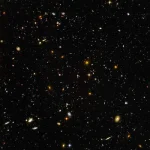
In the image below, taken by the Hubble Space Telescope, there are 10,000 visible galaxies each containing billions and billions of stars.

If you took a needle out and held it to the night sky and looked through the hole on the end - that is the equivalent portion of space in the picture.

To cover the whole sky the same technique would have to be used roughly 40,000,000 times.
 

Attachments

  • 800px-Hubble_ultra_deep_field_high_rez_edit1.webp
    800px-Hubble_ultra_deep_field_high_rez_edit1.webp
    71.3 KB · Views: 26
Spikey Enthusiast
The little Milky Way alone is flush with billions of potentially habitable planets - and that's just one sliver of the universe (there are billions of other galaxies to choose from).

In total around about 6 sextillion (x21 zeros) possible habitable planets in the universe, more than there is individual specs/grains of sand on all of the earths beaches combined.
 
Boot Cleaner Collaborator
The James Webb Space Telescope captures incredible new image of the Pillars of Creation from more than 6,000 light years away in the Eagle Nebula, discovered in 1745

These beautiful columns are made up of cool interstellar gas and dust which appear at times semi-transparent in near-infrared light.

The pillars were first spotted by NASA 's Hubble Space Telescope in 1995.

The space telescope's new view will help researchers update models of star formations by identifying more precise counts of newly formed stars, along with the quantities of gas and dust in the region

NASA explained: "Newly formed stars are the scene-stealers in this image from Webb's Near-Infrared Camera (NIRCam).

"These are the bright red orbs that typically have diffraction spikes and lie outside one of the dusty pillars.

"When knots with sufficient mass form within the pillars of gas and dust, they begin to collapse under their own gravity, slowly heat up, and eventually form new stars."
 

Attachments

  • 1666305265694.webp
    1666305265694.webp
    110.2 KB · Views: 2
Dylan Rising Star
The James Webb Space Telescope captures incredible new image of the Pillars of Creation from more than 6,000 light years away in the Eagle Nebula, discovered in 1745

These beautiful columns are made up of cool interstellar gas and dust which appear at times semi-transparent in near-infrared light.

The pillars were first spotted by NASA 's Hubble Space Telescope in 1995.

The space telescope's new view will help researchers update models of star formations by identifying more precise counts of newly formed stars, along with the quantities of gas and dust in the region

NASA explained: "Newly formed stars are the scene-stealers in this image from Webb's Near-Infrared Camera (NIRCam).

"These are the bright red orbs that typically have diffraction spikes and lie outside one of the dusty pillars.

"When knots with sufficient mass form within the pillars of gas and dust, they begin to collapse under their own gravity, slowly heat up, and eventually form new stars."
That is pretty cool.

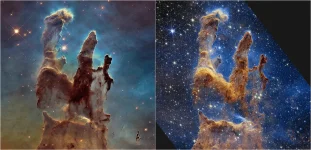
1666363823254.webp

Image on the left is the Hubble telescope; right is the James Webb telescope
 
Birdman Community Regular
The James Webb Space Telescope captures incredible new image of the Pillars of Creation from more than 6,000 light years away in the Eagle Nebula, discovered in 1745

These beautiful columns are made up of cool interstellar gas and dust which appear at times semi-transparent in near-infrared light.

The pillars were first spotted by NASA 's Hubble Space Telescope in 1995.

The space telescope's new view will help researchers update models of star formations by identifying more precise counts of newly formed stars, along with the quantities of gas and dust in the region

NASA explained: "Newly formed stars are the scene-stealers in this image from Webb's Near-Infrared Camera (NIRCam).

"These are the bright red orbs that typically have diffraction spikes and lie outside one of the dusty pillars.

"When knots with sufficient mass form within the pillars of gas and dust, they begin to collapse under their own gravity, slowly heat up, and eventually form new stars."
Another stunning image from Webb
 
Ray Gin Enthusiast
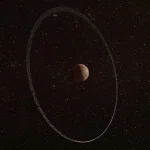
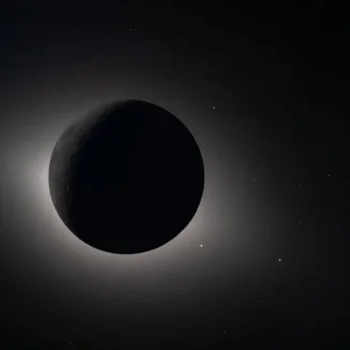
Astronomers have spotted a ring around a dwarf planet called Quaoar in the outer reaches of the solar system.

Prof Vik Dhillon, of the University of Sheffield's department of physics and astronomy, and his co-authors, said: "The ring came as a real surprise and doubly surprising was where it was, well outside the theoretical maximum for where a ring can survive according to classical theory. These are the most unusual rings we've seen."
 

Attachments

  • 20230216-0001.webp
    20230216-0001.webp
    143.8 KB · Views: 2
John Steed Contributor
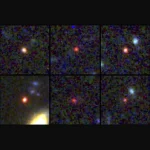
NASA has discovered six giant galaxies that are so ancient, researchers have said that they shouldn't even exist anymore.

A team of astrophysicists found the mysterious objects hiding in images taken from the James Webb Space Telescope, which was published in a study (22 February).

Nearly as old as time itself, researchers found that the giant galaxies seemingly appeared shortly after the dawn of the universe.

Roughly 500 to 700 million years after the Big Bang - to be exact - when the universe was just 3 percent of its current age.
 

Attachments

  • 001.webp
    001.webp
    107.8 KB · Views: 1
John Steed Contributor
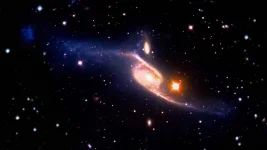
This is the largest known spiral galaxy.

nasa-20230228-0001.webp

This image processed in 2013 reveals a colossal galaxy. At roughly 522,000 light-years from tip-to-tip across its two outsized spiral arms, this galaxy is more than five times the size of the entire Milky Way.

This cosmic behemoth's unusual size and appearance stem from its gravitational interaction with a much smaller disk galaxy, which is only about one-fifth of its mass. This odd duo is located 212 million light-years from Earth in the southern constellation Pavo.

To crown this galaxy as the largest yet, astronomers combined visible light images from the European Southern Observatory's Very Large Telescope with archived far-ultraviolet data from NASA's Galaxy Evolution Explorer and infrared data acquired by NASA's Spitzer Space Telescope.

Image description: A composite image of a giant barred spiral galaxy. In the center of the image, a large spiral-shaped galaxy dominates outwards in shades of yellow, red, and blue. The large galaxy's center shines brightest in light yellow, its two blueish spiral tails extending far into space. Visible as an oblong disk above the large galaxy, a smaller galaxy can be seen, its gravitational effect stretching and disrupting the larger of the two galaxies. In the upper left of the image, the faint ultraviolet glow of new star birth within a tidal dwarf galaxy can barely be made out as a bloom of misty blue atop the deep blackness of space. The background of the image includes numerous distant galaxies sprinkled throughout in shades of yellow, blue, and red.
 
Ghost Explorer
nasa-20230314-0001.jpg

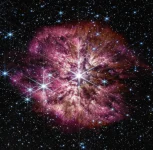
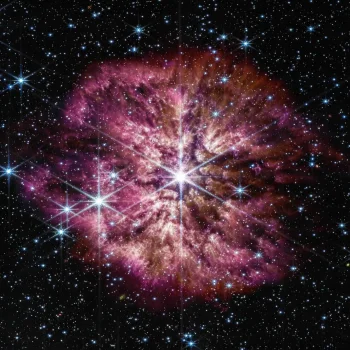
A large 8-pointed star shines in bright white at the center. A clumpy cloud of material surrounds this star, in some places allowing background stars to peek through. The cloud is a dark yellow closer to the star, and turns a pinkish purple at its outer edges. Combined, the central star and its cloud resemble a cherry blossom. The black background features many smaller white stars scattered throughout.⁣

Sakura to Supernova⁣

This rare sight is a super-bright, massive Wolf-Rayet star. Calling forth the ephemeral nature of cherry blossoms, the Wolf-Rayet phase is a fleeting stage that only some stars go through soon before they explode.⁣

The star, WR 124, is 15,000 light-years away in the constellation Sagittarius. It is 30 times the mass of the Sun and has shed 10 Suns worth of material – so far. As the ejected gas moves away from the star and cools, cosmic dust forms and glows in the infrared light.

The origin of cosmic dust that can survive a supernova blast is of great interest to astronomers for multiple reasons. Dust shelters forming stars, gathers together to help form planets, and serves as a platform for molecules to form and clump together, including the building blocks of life on Earth. The James Webb Space Telescope opens up new possibilities for studying details in cosmic dust, which is best observed in infrared wavelengths of light.⁣
 
John Steed Contributor
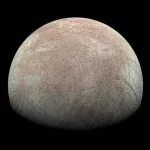
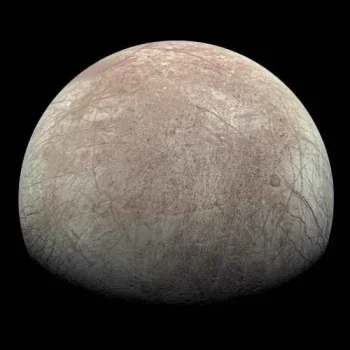
Partially illuminated, Europa's surface is marred and cracked with brown-gray streaks creating patterns across its icy shell, which appears white and blue.

nasa-20230321-0001.webp

Scientists have long suspected Jupiter's moon, Europa, of having a massive ocean swirling around its rocky interior under its icy shell. New research may indicate why the icy shell rotates at a different rate than its interior. Using computer modeling, astronomers believe the water may be pushing the ice shell at different rates speeding up and slowing down the icy shell over time.

The ebb and flow of the ocean may also explain the geology seen on the moon's surface, creating cracks, ridges, and cliffs as seen here by our Juno spacecraft. Scientists hope to learn more about Europa's unique make-up with our Europa-Clipper set to launch in October 2024, which will study the moon in-depth.
 
Back
Top Bottom