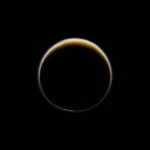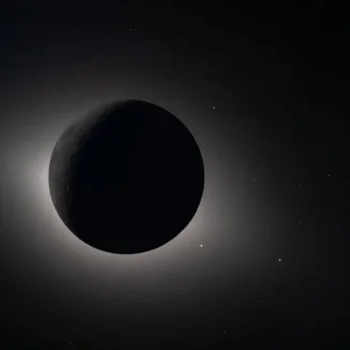
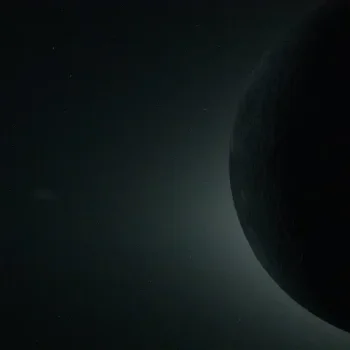

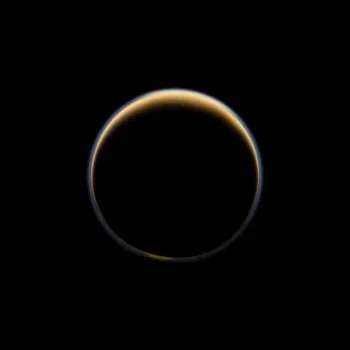



NASA's Cassini spacecraft looks toward the night side of Saturn's largest moon and sees sunlight scattering through the periphery of Titan's atmosphere and forming a ring of color. Because we're viewing the dark side, the icy moon looks like a black sphere in a sea of darkness, with its spherical shape recognizable only by the visible ring of its atmosphere around the outside of the planet.
First discovered 368 years ago this week by Galileo, Saturn's largest moon – Titan – is the sole other place in the solar system known to have an earthlike cycle of liquids raining from clouds, flowing across its icy surface, filling lakes and seas, and evaporating back into the sky. Beneath the thick ice surface, evidence suggests there is a water ocean that could potentially harbor life. Primarily composed of nitrogen, Titan's thick atmosphere suggests the moon formed early in our solar system's history.
First discovered 368 years ago this week by Galileo, Saturn's largest moon – Titan – is the sole other place in the solar system known to have an earthlike cycle of liquids raining from clouds, flowing across its icy surface, filling lakes and seas, and evaporating back into the sky. Beneath the thick ice surface, evidence suggests there is a water ocean that could potentially harbor life. Primarily composed of nitrogen, Titan's thick atmosphere suggests the moon formed early in our solar system's history.