
• NFL Fantasy registration period is now closed. The Draft will take place on August 30 at 8pm.
    EPL and NFL Pickem pools are now open for registration
    EPL Ultimate Team is now open for registration. The new season kicks off on August 21 2026.
    NEW GAME: Club Manager is now live. Go register your team for the upcoming season.

The Universe: Space Exploration Discussion Thread General Chat 

Thread Insights Discussion AI
Exploring the cosmos reveals astonishing discoveries.
7/10 Informational

The post presents an interesting fact about galaxies and provides a relatable analogy, enhancing community engagement. However, it could benefit from deeper insights or questions to stimulate discussion.

James Webb Telescope NASA discoveries galaxies habitable planets solar system

The thread begins with a focus on the vastness of the universe, featuring Hubble's images showcasing dense galaxies and discussions about the immense number of habitable planets within the Milky Way and beyond. Contributions highlight the cutting-edge findings from the James Webb Space Telescope, illustrating incredible structures like the Pillars of Creation.12

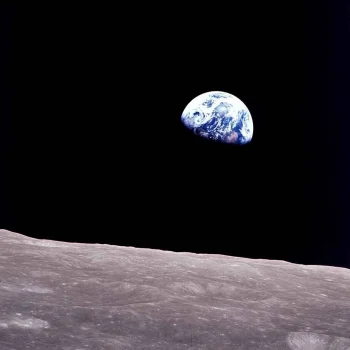
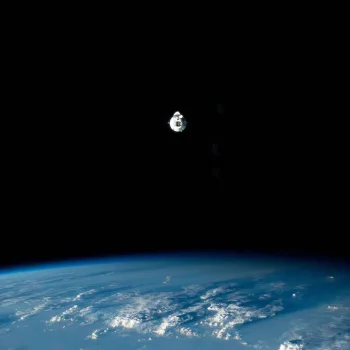
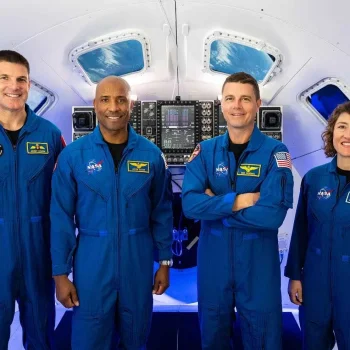
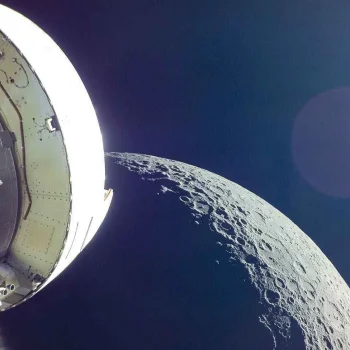
As the conversation progresses, a variety of significant discoveries emerge, including newly identified ancient galaxies, and the announcement of astronaut missions to the Moon, showcasing the active role of agencies like NASA and SpaceX in space exploration. Users express excitement over recent advancements in technology serving to unveil cosmic mysteries.34

In the later discussions, users reflect on the mesmerizing visuals captured by space missions, leading to a deeper appreciation for both our planet and the greater universe. The thread encapsulates the thrill of discovery in space exploration and points towards the potential for life indicators found on distant exoplanets.56

"James Webb Space Telescope may have detected life indicators on distant planet K2-18b."

Verdict

While the thread successfully showcases remarkable achievements and information in space exploration, it leaves open the curiosity about life beyond our planet. The excitement and anticipation among users illustrate a growing interest in future discoveries.

Similar threads
John Steed Contributor
Researchers from the Space Medicine Team, European Space Agency in Germany have conducted a study published in Scientific Reports that found female astronauts have lower water requirements for hydration, total energy expenditure, oxygen (O2) consumption, carbon dioxide (CO2) and metabolic heat production during space exploration missions compared to their male counterparts.

In the study, "Effects of body size and countermeasure exercise on estimates of life support resources during all-female crewed exploration missions," the team utilized an approach developed to estimate the effects of body "size" on life support requirements in male astronauts. For all parameters at all statures, estimates for females were lower than for comparable male astronauts.

When considering the limited space, energy, weight, and life support systems packed into a spacecraft on a long mission, the study finds that the female form is the most efficient body type for space exploration. (Phys.org)
 
8-Ball Enthusiast
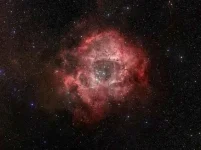
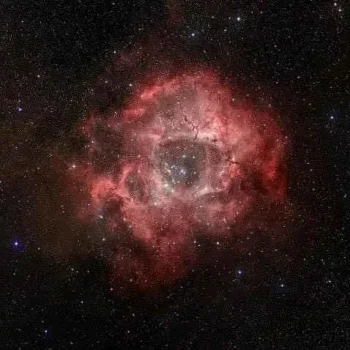
The Rosette nebula, a star forming region located about 5,000 light-years from Earth, is home to young star clusters. This composite image captured by Spitzer Space Telescope, reveals some of the Rosette's most massive stars, called O stars, inside the bubble-like red cavity as bright blue stars. However, the two largest blue stars in this picture are in the foreground, not the nebula itself. Radiation and winds from the super-hot stars have collectively blown layers of dust (green) and gas away, revealing the cavity of cooler dust (red). ⁣

Nebulas, known as "star nurseries," are made of dust and gases, mostly hydrogen and helium. The dust and gases in a nebula are very spread out, but gravity can slowly begin to pull together clumps of dust and gas. As these clumps get bigger and bigger, their gravity gets stronger and stronger.⁣

Image description: Clouds of gases in shades of pinks and reds overlap each other in a formation that resembles a flower. The inside of the gasses glows white, while more saturated reds envelope the outer edges. Deep space dotted with distant stars and galaxies surrounds the nebula. Bright stars are scattered around the outer edges and in the center of the nebula. ⁣
 

Attachments

  • nasa-20230514-0001.webp
    nasa-20230514-0001.webp
    60.6 KB · Views: 0
John Steed Contributor
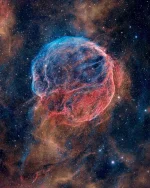
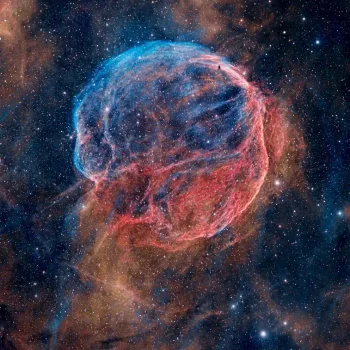
The Medulla Nebula Supernova Remnant.
 

Attachments

  • earth-20230517-0001.webp
    earth-20230517-0001.webp
    539.6 KB · Views: 0
Black Sheep Collaborator
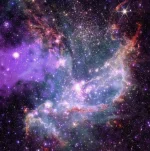
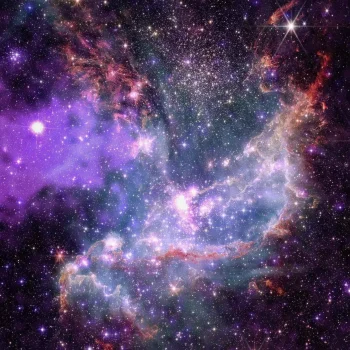
NGC 346, a star cluster in a nearby galaxy, the Small Magellanic Cloud, lights up as Chandra (in purple and blue) reveals young, hot, massive stars that send powerful winds outward from their surfaces. Webb shows arcs of gas and dust that stars and planets use as a source of material for their formation in red, green and blue.⁣

nasa-20230526-0001.jpg
 
Black Sheep Collaborator
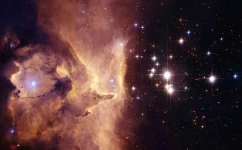
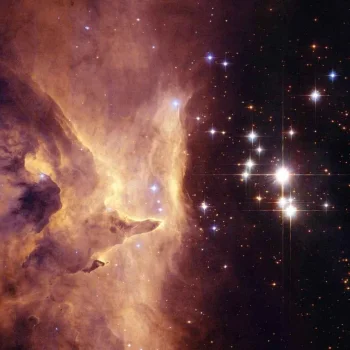
This Hubble photo is visually split into two equally-sized areas. On the right side, a handful of bright white-and-blue stars stand out against the background of space. On the left side, swirling clouds of orange, red, and black make up a gigantic nebula, with a rounded tendril appearing to extend towards the starfield on the right. This image has been rotated 90 degrees clockwise from its original orientation.
 

Attachments

  • nasa-20230602-0001.webp
    nasa-20230602-0001.webp
    96 KB · Views: 0
Random Guy Enthusiast
Snoops Enthusiast
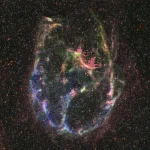
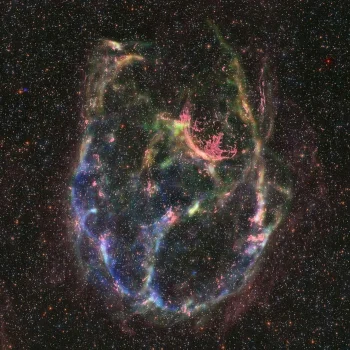
N132D, the brightest supernova remnant in a satellite galaxy of the Milky Way known as the Large Magellanic Cloud (LMC). Located about 160,000 light-years from Earth, N132D is the remains of a star roughly 15 times the mass of our Sun.
 

Attachments

  • nasachandraxray-20230623-0001.webp
    nasachandraxray-20230623-0001.webp
    417.1 KB · Views: 0
John Steed Contributor
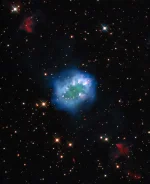
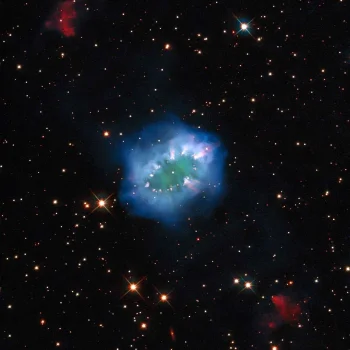
Located 15,000 light years away, the "Necklace Nebula" known as PN G054.203.4 was created by a pair of tightly orbiting Sun-like stars. About 10,000 years ago, an aging star expanded to the point where it immersed into its companion star. The pair of stars orbiting closely together produced the nebula creating bright knots of gas that resemble diamonds in a necklace. ⁣

Measuring 12 trillion miles wide, this pair can orbit one another in a little over a day. Although the pair of stars are only a few million miles apart, they can be found in the constellation Sagitta (the Arrow). ⁣

nasa-20230724-0001.webp

Image description: At the center of the image, a green core surrounded by a ring of bright-shiny clumps of gas. A cloud of gas surrounds the ring. The background is dark and filled with small, medium, and larger stars. Small red clouds of gas are at the top left and bottom right of the image. ⁣
 
Son Of Jack Enthusiast
The Eagle Nebula

Near-infrared light allows us to see beneath the gas and dust, revealing a countless number of stars hidden behind the nebula and pillars. The dusty blue haze around the pillars is caused by intense ultraviolet radiation from a cluster of young stars which will eventually evaporate into space. With these wavelengths, astronomers are able to see the next generation of emerging stars.

The entire frame is peppered with glittering bright stars. At the center of the image, the outline of three pillars extends upward, surrounded by a blue haze. Black dust and clumps at the center bottom of the image.⁣
 
Black Sheep Collaborator
NASA has restored full contact with the Voyager 2 spacecraft, after previously losing contact for accidentally sending the wrong command.

On Friday (Aug. 4), JPL announced in a mission update that NASA's Deep Space Network facility in Canberra, Australia was able to send a command into interstellar space that reoriented the spacecraft and pointed its antenna back towards Earth. Mission controllers had to wait 37 hours to learn if the command was successful. And it was.

"The spacecraft began returning science and telemetry data, indicating it is operating normally and that it remains on its expected trajectory," JPL said in the statement.
 
Previous Thread
Ozzy47 Ozzy47 5 905
Next Thread
Donna Donna 5 761
Back
Top Bottom