• The new season of NFL Fantasy is now open for registrations. Anyone wishing to participate please sign up before August 16 2026.
    EPL and NFL Pickem pools are now open for registration
    EPL Ultimate Team is now open for registration. The new season kicks off on August 21 2026.
    NEW GAME: Club Manager is now live. Go register your team for the upcoming season.

Man City Are Suing The Premier League Soccer 

Thread Insights AI
8/10

The post provides a clear and detailed overview of the legal case, including relevant historical context and specifics about the rules in question. It could improve by offering a personal insight or perspective to enhance engagement.

Black Sheep Collaborator
In essence the rules will now be rewritten.

Until the new rules come into effect clubs like City and Newcastle can do whatever they like re sponsorship.

One commentator online is speculating City could shore themselves up financially this way in the case of a negative (for them) outcome in their 115 charges case.

Screenshot_2024-10-07-16-44-27-125_com.android.chrome.png
They'll have to basically update the procedure to account for low/zero percentage shareholder loans essentially - City won't be able to force through any inflated sponsorships, it will still have to be approved by the Premier League.
 
Tom Rising Star

Tom

Over the next few posts is brief summary of the verdict (source The Athletic)

What Happened?

The judgment shows that it was delivered to both City and the Premier League on September 25 — just under two weeks ago.

In the intervening period, both sides have had time to digest, and are desperate to make it appear as if they won the day.

For example, while City released a statement containing eight bullet points, each purporting to be a major win, the Premier League asserted that "the tribunal upheld the need for an APT system as a whole and rejected the majority of Manchester City's challenges."

The headlines are these.....

Firstly, the panel was supportive of the concept of APT laws — seeing them as a necessary part of PSR regulations. City was not successful in getting them thrown out as a broader concept.

However, the panel did find procedural issues in how two of City's applications were handled — potential deals with the airline Etihad and the First Abu Dhabi Bank (FAB) — concluding these were unfairly blocked.

Additionally, in potentially the most significant finding from the case, the panel also ruled that interest-free shareholder loans should fall under APT laws — which City argue will bring other clubs in line with the level of regulation they face.
 
Tom Rising Star

Tom

What points did City win on?

Broadly, the panel found there were three areas where the Premier League's rules were unlawful, or where decisions were reached unfairly.

Benchmarking
This is a procedural detail. Clubs must submit all deals to a fair market value test — but currently do not have the opportunity to view the data which the Premier League benchmarks it against beforehand.

City argued this denied them "the proper opportunity to make informed representations", while the Premier League stated this had been done because of "the confidential nature of the proposed transactions".

The panel sided with City — though in practice, the judgement reads more like a negotiation between the parties, with the Premier League assured that certain information could be shared pre-submission as long as existing confidentiality processes were respected.

Nevertheless, because the Premier League had previously blocked this, the rules as written were found "unlawful" because they were "procedurally unfair". This will be a simple rule tweak.

However, the implication is that two of City's deals which were rejected under this framework — sponsorship agreements with Etihad and FAB — were found to have been blocked unlawfully, because City were denied the opportunity to respond to the existing benchmarking analysis.

Near the end of the judgement, the panel concludes that City have the right to pursue damages — potential losses from these deals are liable to be explored.

Decision-making delays
Under the existing system, the Premier League has a timeframe by which they must respond to all APT applications.

City claimed this was breached in three cases — the previously discussed deals with Etihad and the FAB, as well as another separate agreement with Emirates Palace, a government-owned subsidiary which owns a luxury Abu Dhabi hotel.

Here, the Premier League exceeded the 25-day guidance, citing a lack of resources within their own regulatory team.

The panel concluded that though there was no evidence that City lost an APT transaction because of these delays, nor had the club shown that other potential sponsors had been spooked by the prospect of delays, the Premier League had still broken its own laws during the Emirates Palace and FAB transactions by creating an unreasonable delay.

The Etihad deal was not included after the Premier League dropped any objection to the application. This is another area where City could seek damages — however, it will not lead to a law change.

Shareholder loans
This is the most significant part of the judgement — necessitating a rule change which may have major implications for other Premier League clubs.

Within their judgement, the panel were tasked with defining exactly what constitutes an associated party transaction (APT).

City argued that, as well as sponsorship deals, shareholder loans should also be taken into account. Historically, these have been excluded from the APT rules.

Shareholder loans are when a club borrows money from its ownership group — with many teams doing this interest-free, benefiting the club because they will subsequently owe a smaller amount.

For example, as of 2022-23, Arsenal have borrowed £ 259 million in shareholder loans from their owners, Kroenke Sports & Entertainment, while Everton's interest-free loan from majority shareholder Farhad Moshiri now stands at around £450m. Brighton & Hove Albion's owner, Tony Bloom, has invested over £400m in interest-free loans since taking over the club in 2009.

City claimed this was a major competitive advantage — the sort of loophole which APT laws were already cutting out when it came to sponsorship deals.

Their argument was that this distorts PSR calculations — as a matter of principle, an interest-free loan cannot be fair market value.

In an early submission, they made the case that if APT laws were restricted to only APTs from Gulf states, it would be discriminatory — so why should APT laws be restricted only to sponsorship deals, rather than shareholder loans?

The independent panel agreed with them, declaring "we can see no difference in principle between that situation and limiting the ambit of the APT rules to exclude shareholder loans".

As a result, they stated that the exclusion was "unlawful" — and correspondingly, the Premier League's laws will need to be changed.

In theory, this means that when interest-free shareholder loans are included within PSR, some of City's rival clubs may have to rebalance their books in order to avoid a breach. More on that later, too.

Additionally, because the panel stated that the Premier League reached the decision to exclude shareholder loans deliberately, this constituted a breach of competition law "by object" — which City sources claim is more serious than "by effect" (i.e. inadvertently).

Legally, this amounts to an abuse of the Premier League's dominant position, which City can utilise as evidence in any damages claim.

In the Premier League's response to this part of the judgement, they noted that excluding shareholder loans was voted for by 19 clubs — including Manchester City.
 
Tom Rising Star

Tom

What points did the Premier League win on?

City's challenges to APT laws were far more widespread than the points they won above.

For example, City claimed that APT rules were "inherently incapable of capturing the specific features" of some agreements and amounted to "price fixing" which was a restriction on their earning potential.

This was given short shrift by the panel, who stated that: "it is difficult to see how the PSR can be effective without such a mechanism".

The judges also concluded that the fair market value regulations, as written, were "clearly defined, transparent and non-discriminatory". City's win on the Premier League's delays came because they had broken their own rules, not because of any essential issue with the rules themselves.

Significantly, the panel also rejected several submissions from City which argued that they had been the victims of bias.

For example, they stated both that the Premier League regulatory team "can be relied upon to conduct (fair market value tests) competently and fairly without any perception of bias" and that they "do not find that APT rules were targeted specifically at clubs in the Gulf region".

City would have a far stronger case for damages if both these had gone against the Premier League.
 
Tom Rising Star

Tom

What happens next?

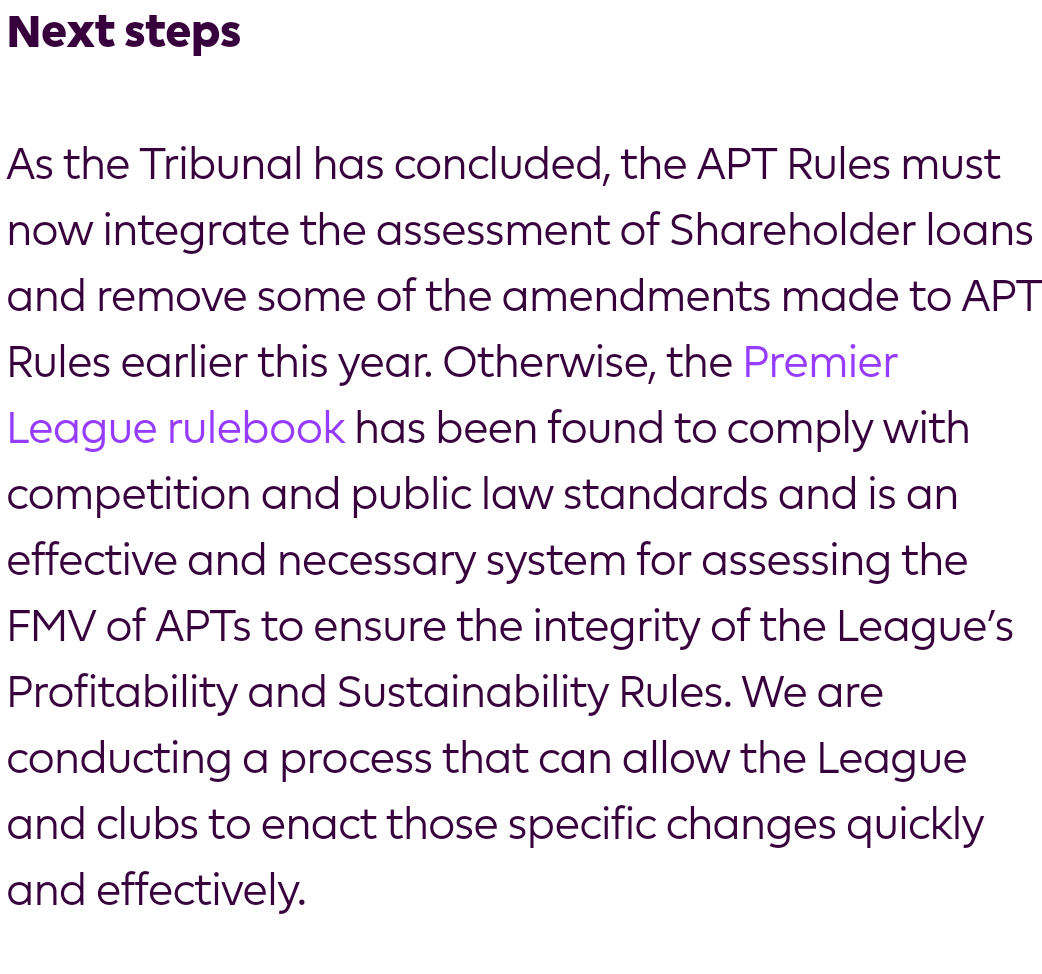
There will be one major rule change — the integration of shareholder loans into existing APT laws.

Under competition rules, clubs will need to formally vote for this at the next Premier League meeting.

This will have the greatest effect on teams who have previously benefited from interest-free loans — clubs like Everton, Arsenal, Brighton and Chelsea. If this change in the rules is passed, they will subsequently have less PSR wiggle room than previously thought and will have to adjust their spending accordingly.

It will not signal an APT free-for-all when it comes to sponsorship deals, with the mechanism for deciding fair market value deemed broadly fair.

Though City might argue that having additional access to benchmarking data will allow them to maximise deals, they will still only be maximising them within the existing APT framework.

They will, however, be able to seek damages for their three wins — access to benchmarking, unfair delays to sponsorship deals, and the implementation of shareholder loans in APT.

However, it is highly unlikely that the amount they would be paid, should they pursue damages, would be any great needle-mover in the power dynamic of the league.
 
Dylan Proficient
Listened to some discussion about it on TalkSport last night. I think the reality is dawning. The discussion isn't so much about who won, but is the Premier League fit for purpose.

I think that is City's main objective.

This probably wouldn't have happened if the 115/130 charges case didn't exist is basically what they were saying.

Stuff like this is why my interest in football is waning. It is all about money nowadays.
 
Strawberry Man Contributor
In a significant development, Manchester City and the Premier League have reached a settlement regarding the legal dispute over the associated party transaction (APT) rules. This settlement marks the conclusion of proceedings that began with City's legal challenge in January, where they argued that amendments to the APT rules were "unlawful and void."

Both parties have now agreed on the validity of the current APT rules, which were introduced to ensure financial stability and competitive balance within the league by regulating commercial revenues from linked entities. The APT rules, amended twice in 2024, aim to prevent clubs from gaining unfair advantages through enhanced revenues connected to their ownership.

City's contention was that the amended rules were discriminatory, particularly regarding scrutiny of shareholder loans compared to other commercial deals. They believed these loans should also undergo fair market value assessments retrospectively.

The settlement comes amidst ongoing discussions about City's sponsorship agreements, notably with Etihad Airways, and follows a series of legal confrontations between the club and the Premier League. Notably, an independent panel had previously deemed some of the APT regulations unlawful, prompting a reevaluation by the league.

As of now, both Manchester City and the Premier League have opted not to provide further comments on this matter. The legal proceedings have been complex, with a judgment regarding 115 charges against City still pending, to which the club has denied any wrongdoing.

In summary, here are the key points from the settlement:

Key Points:
  • Manchester City and Premier League settle dispute over APT rules.
  • City accepts APT rules as valid, following a legal challenge.
  • Amendments to rules aimed at financial stability and competitive balance.
  • City argued rules were discriminatory regarding shareholder loans.
  • No further comments from either party post-settlement.
  • Judgment on ongoing charges against City is still awaited.
 
Next Thread
David76 David76 5 387
Back
Top Bottom