• The new season of NFL Fantasy is now open for registrations. Anyone wishing to participate please sign up before August 16 2026.
    EPL and NFL Pickem pools are now open for registration
    EPL Ultimate Team is now open for registration. The new season kicks off on August 21 2026.
    NEW GAME: Club Manager is now live. Go register your team for the upcoming season.

Man City Are Suing The Premier League Soccer 

Thread Insights AI
8/10

The post provides a clear and detailed overview of the legal case, including relevant historical context and specifics about the rules in question. It could improve by offering a personal insight or perspective to enhance engagement.

C Collaborator
Last edited:
Manchester City's legal case against the Premier League's associated party transaction (APT) rules will begin on Monday, June 10.

City are suing the league in an attempt to have the rules — which they claim are unlawful — abolished in a two-week private arbitration hearing.

The Premier League's APT rules were originally introduced in December 2021 after the Saudi-backed takeover of Newcastle United.

The regulations are in place to guard against clubs using sponsorship deals with companies linked to their owners to inflate revenue streams and allow more room for spending.

In February, Premier League clubs voted to toughen rules on associated party transactions.

Reported at the time of the vote, Premier League CEO Richard Masters said one club — believed to be City — had argued the rules could be in contravention of competition law and had threatened legal action. The league insisted they were fully compatible with the law.

According to The Times, City now argue that they are the victims of "discrimination" in a 165-page legal document justifying their case. City are also arguing the league's democratic system of requiring at least 14 clubs, or two-thirds of those who vote, to implement rule changes should be abolished to guard against decisions being made by "the tyranny of the majority".

The case itself seems reasonable, although not everybody agreed: City are understood to be looking for a change to the APT regulations, rather than an abolishment of them, and they make the case that those rules go against UK competition law. Senior sources at other clubs believe they have a good chance of winning — it is not a frivolous case to bring.

But some of the arguments, while perfectly normal in a legal setting, are hard to swallow because they appear to use the very essence of football — fans and community — almost as bargaining chips.

"City argue that the present rules will limit their ability to buy the best players, and force them to charge fans more for tickets," the article in The Times reads. "They say they may also have to cut spending on youth development, women's football, and community programmes."

This is where the reality of all of these battles has begun to hit home, for some.

It could certainly be argued in court that restricting the club's income from sponsorships might lead to a rise in ticket prices to make up the difference, but the court of public opinion could easily decide that City would put prices up anyway, as they had been doing for other reasons for years before these APT rules were brought in.

 
C Collaborator
[H2]What are the APT rules?[/H2]
Rules already existed, but tightened-up regulations were first rushed into place immediately after the Saudi-led takeover of Newcastle United was eventually approved in October 2021. Rival clubs feared Newcastle's new owners — Saudi Arabia's Public Investment Fund (PIF) — could use their vast array of companies to strike a multitude of inflated sponsorship deals. This would drive revenue and circumvent PSR rules.

The clubs initially voted for a temporary suspension but eventually agreed on a framework which would see all associated-party transactions subjected to a fair market value test. Essentially, teams would have to prove that any deal was financially justifiable to all parties based on the going rate.

For example, Newcastle's sponsorship deals with PIF-linked events company Sela and e-commerce company Noon were both subject to this test.

A new version of these rules was then agreed in February of this year.

[H2]So what is City's complaint?[/H2]
City have always opposed or abstained when voting on the introduction of these policies in Premier League meetings — the club's sponsorship network has historically been tied to figures who sit on the board of the City Football Group (CFG).

For example, title sponsor Etihad — whose name sits on both the club's shirt and stadium — is the state airline of the United Arab Emirates. City's owner — the Abu Dhabi United Group (ADUG) — is a private equity company with strong links to the UAE government. ADUG insists the two are separate. Nevertheless, until August 2021, Etihad was chaired by Mohamed Al Mazrouei — who sat on City's board until January 2022.

In 2022, it was reported that City received in excess of £67.5m per year from Etihad for their sponsorship of the club.

City recorded Premier League record revenues in 2022-23, bringing in £712.8m, of which almost half — £341.4m — was commercial income. That is 13 per cent bigger than Manchester United, English football's traditional commercial powerhouse. City's commercial income is up 50 per cent since 2019 and now makes up 48 per cent of total revenue.

As an aside, City and Newcastle are not alone in this — Leicester City's owners, King Power, for example, sponsor the club's stadium, jersey and training kit. However, City and Newcastle's close links to state investment offer them a far deeper well — which is why rival Premier League clubs mobilised to close the loophole.

In February, new rules were agreed. At the same meeting, Premier League chief executive Richard Masters informed clubs that an unnamed club — named as City at the time — was threatening legal action in response, claiming the new regulations were in breach of competition law.

That has now come to pass — in a two-week hearing which will take place in private from next Monday. According to a source with knowledge of the situation, who like all those spoken to for this article asked to be kept anonymous as they did not have permission to speak, City deem the rules to have been rushed through — the first suspension of APT laws came just four days after Newcastle's takeover was finalised — and believe the rules were applied in a targeted manner. That City source, however, stressed that the club does want some form of regulation to remain — albeit in a guise they would view as non-discriminatory.

According to a 165-page legal submission seen by British newspaper The Times, City have argued that they have suffered "discrimination" as a result of the new rules, alleging they amounted to a "tyranny of the majority". The Premier League requires a majority of 14 clubs to impose new regulations.

The Times also reported that City will seek damages for losses they claim to have suffered since APT laws were introduced.

UEFA, incidentally, have their own fair-market value test. City's legal case does not address those laws and the club will still have to comply with them in European competition. And according to a source, at least one European superclub is following proceedings closely, wary of the implications that a growth in City's revenue could have.

[H2]How much support do City have?[/H2]
Rival clubs are able to make their voices heard by providing witness statements or evidence in favour of either City or the Premier League.

In theory, Newcastle are natural allies with City — an end to APT rules would facilitate several further lucrative sponsorship deals with PIF-owned companies. Newcastle have been operating close to their PSR limits and may face the need to sell a prize asset in the summer, but increasing their revenue allows them to continue investing in their squad.

Sources with knowledge of the situation said other Premier League clubs are also considering supporting City due to their own potential abilities to take advantage of APT rules in future. Others, while they support the regulations in principle, agree with City that the rules were hurriedly implemented and could be improved upon.

However, the majority of the league will still be hoping City lose their case — although as this matter will take place under competition law in private arbitration, rather than be subject to a Premier League vote, their voices ultimately carry limited sway.

Teams have always sought to maintain pressure on the Premier League over City's ability to spend. This has included informal phone calls to Premier League HQ from owners and chief executives of its clubs, or even legal letters or requests for information that would land at the Premier League.

[H2]What will happen if City win?[/H2]
At a basic level, teams such as City and Newcastle will be able to immediately strike several deals and enter this summer's transfer market with renewed force. Other clubs may scramble to find related-party sponsorship deals of their own to circumvent PSR laws.

Last season, two teams — Everton and Nottingham Forest — faced points deductions for breaching PSR rules. A promoted team (Leicester City) are facing an identical charge. These regulations financially capped the majority of teams. Success for City has the potential to upend the league's financial landscape.

There is a strong correlation between wage bills and finishing positions — clubs who can increase sponsorship revenue can put that money directly into player contracts without fear of a points deduction.

But the implications could be even wider.

"If a challenge to the legality of these APTs can succeed, then it is not inconceivable that someone might try to challenge the overarching profit and sustainability rules more generally," says Daniel Gore, a senior associate at law firm Withers, who specialises in competition law and arbitration.

"This could reverse the moves made to ensure that clubs operate within their means — something people may argue has increased the overall competitiveness of the Premier League and reduced clubs going insolvent."

City's objection to the Premier League's 'two-thirds majority' framework — which they termed as "tyranny" — directly challenges the league's democratic process.

"This is a common threshold for corporate procedure and means that there is a reasonable and transparent process," says Gore. "It is hard to see how effective governance could take place without a threshold such as this, so Manchester City's challenge could plunge the Premier League's governance structure into chaos and make it harder for any decision to take place."

[H2]What will happen if City lose?[/H2]
Nothing, in a literal sense. The rules will remain as they are — though City always have the ability to attempt to table a vote to change the regulations in a Premier League meeting.

However, this is just part of City's battle against the Premier League. Sometimes, it is easy to forget that the league's dominant team — its victors for six of the last seven seasons — have been either investigated or in open dispute with the Premier League for almost the entirety of that time.

If City lose their challenge over APT regulations and are found guilty of breaching a number of the 115 FFP charges, relationships with the Premier League will be at an all-time low, raising the possibility of City entering open revolt by seeking to rejoin the ESL.
 
C Collaborator
[H2]Is this linked to the 115 charges?[/H2]
Yes and no. On the one hand, the 115 charges relate to allegations of past financial breaches — essentially, disguising payments made to the club by their ownership as sponsorship revenue, with those sponsorship deals themselves inflated. In contrast, City's APT dispute will govern what they are allowed to do going forward.

However, if APT laws are found to be unlawful — and with City accused of leveraging them by the Premier League — City's defence in the parent case will be significantly strengthened.

Progress in that has been lengthy and contentious, with City's lawyers — led by Lord Pannick, one of the United Kingdom's most expensive barristers — opposing the Premier League at every step.

In one email, published by German newspaper Der Spiegel in 2018, a City lawyer claims that Khaldoon al Mubarak, the club's chairman, had said that "he would rather spend 30million on the 50 best lawyers in the world to sue them for the next 10 years" than agree to any financial settlement or penalty from UEFA — who had been involved in their own lengthy legal process against the English side.

City's legal action here is another way in which the club can muddy the process and attack the Premier League.

[H2]How much of a problem is this for the Premier League?[/H2]
The Premier League's legal capabilities are already stretched — it has already been reported on their need to recruit extra help to deal with the caseload at the end of last season. This will only add to their plate.

In a sense, they are also in a tough spot politically. Even if the Premier League wins this case, the shadow of City's 115 charges still looms — with rival clubs insistent that City must be appropriately punished for what they view as a breach. A verdict is not expected until at least the spring of 2025.

If the Premier League lose, then clubs with links to state ownership will be even more empowered financially, which will lead to fierce questioning from rival sides over the division's credibility.
 
Tom Rising Star

Tom

The Premier League and FA must own this mess. Letting oil rich, Middle-east states purchase football clubs.

These owners have spent their lives with no consequences for doing what they wanted, their money made everything better.

You dance with the devil you are going to get burnt.
 
Boot Cleaner Collaborator
Big fan of Man City (on the pitch) but they need to be defeated for the sake of football.
 
David76 Rising Star
I actually think City will win the challenge against the PL for the APT ruling as that has little basis in any European commercial law regulations. I equally think they will lose the challenge against the voting system though, as that does have a basis in commercial practice for decision making, especially at Board level.

As for the 115, these are completely separate non-related issues as some of the allegations concern fraudulent matters that have far more serious implications than breaching APT rules imposed by clubs on clubs because two of the clubs have state ownership. And that's the crux of the problem with the poorly thought out APT ruling - there is nothing in any rule book that prevents state ownership. Hence, this being the reason why the APT ruling has no basis other than discrimination.
 
G Contributor
Manchester City and the Premier League are both claiming victories after a ruling regarding the league's Associated Party Transaction (APT) regulations was published.

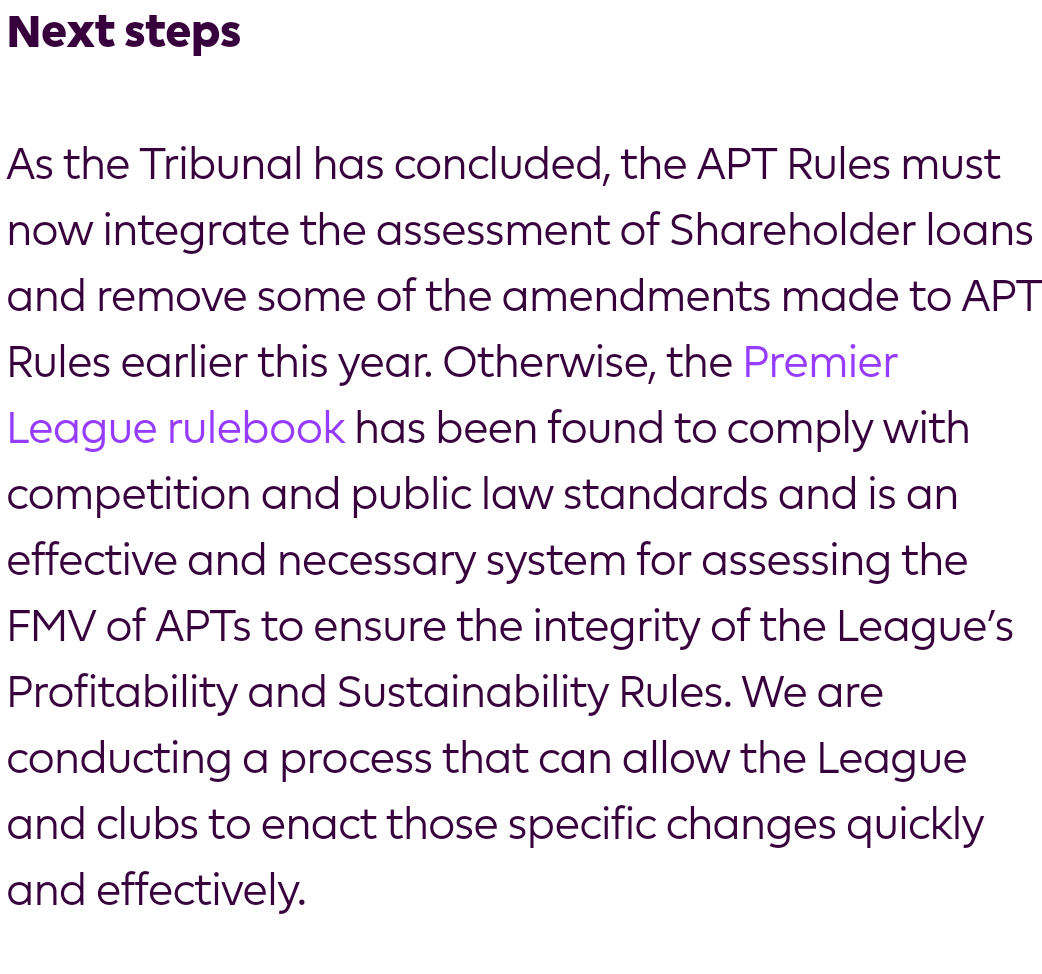
The ruling states that the Premier League's APT rules and amendments, which were introduced in December 2021 and February of this year respectively, are "unlawful" and in breach of UK competition law as they deliberately exclude shareholder loans — when a club borrows money from its ownership group, usually interest-free.

City claimed that the league's APT rules — which aim to regulate against its clubs using sponsorship deals with companies linked to their owners to inflate revenue streams and allow room for greater spending — are unlawful and against competition law. The league insisted that the rules were fully compatible with the law.

A statement from City on Monday outlined that the Premier League "was found to have abused its dominant position" by the tribunal. City also pointed out that the panel has ruled two of the league's decisions on the club's sponsorship deals — relating to the Emirates Air Group and First Abu Dhabi Bank — should be set aside.

The Premier League, meanwhile, said that it "welcomes" the ruling. The league admitted that the verdict identified "a small number of discrete elements" of the APT which do not comply with competition law but claims it "(endorses) the overall objectives, framework and decision-making of the APT system".

The Premier League added that the tribunal had deemed the APT rules "necessary" as a means of ensuring the efficacy of the league's Profitability and Sustainability Rules (PSR), "thereby supporting and delivering sporting integrity and sustainability in the Premier League".

The Premier League says it will continue to operate the APT system, "taking into account the findings" of the tribunal. It added that the elements not complying with competition law "can quickly and effectively" be fixed.

The ruling was delivered by a three-person arbitration panel and came after City challenged the league's APT rules. The case was heard in June.

An amendment to the current APT rules was set to be discussed at a meeting of Premier League shareholders on Thursday but was removed from the agenda.
 
Boot Cleaner Collaborator
In essence the rules will now be rewritten.

Until the new rules come into effect clubs like City and Newcastle can do whatever they like re sponsorship.

One commentator online is speculating City could shore themselves up financially this way in the case of a negative (for them) outcome in their 115 charges case.

Screenshot_2024-10-07-16-44-27-125_com.android.chrome.png
 
Legion Collaborator
It seems like neither side had a clear victory. Only time will tell how the APT rules are now applied and to what effect.
 
Tom Rising Star

Tom

From what I've read and understand, the ruling is absolutely scathing of the Premier League. The only part that wasn't found in City's favour is that the panel rejected the claim that it discriminated against Middle Eastern owners.
 
Next Thread
David76 David76 5 395
Back
Top Bottom