
• The new season of NFL Fantasy is now open for registrations. Anyone wishing to participate please sign up before August 16 2026.
    EPL and NFL Pickem pools are now open for registration
    EPL Ultimate Team is now open for registration. The new season kicks off on August 21 2026.
    NEW GAME: Club Manager is now live. Go register your team for the upcoming season.

NFL Draft 2021 NFL 

  • Date Created Tom
  • Last Reply Snoops
  • Reply Count 13
  • View Count 2K
  • Thread Participants
Thread Insights AI
5/10

The post contains relevant information about the NFL Draft 2021, but lacks depth and analysis. The inclusion of images is not enough to enhance understanding or engagement with the topic.

Tom Rising Star

Tom

1619736961843.png

Location: Cleveland, Ohio
Date(s): Thursday 29th April - Saturday 1st May

The 2021 NFL Draft will be the 86th annual meeting of National Football League (NFL) franchises to select newly eligible players for the 2021 NFL season. The draft is scheduled to be held in Cleveland from April 29 to May 1, 2021. The Jacksonville Jaguars, who finished with the worst record in 2020, hold the draft's first overall selection.

Here's the draft order, number of picks per round and total picks each team has
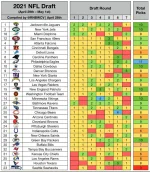
Screenshot_20210430-000218_Chrome.webp
 
Snoops Enthusiast
Just reading through the draft news now. Very surprised the Patriots didn't trade up for Justin Fields when he was so close, much better option than Mac Jones IMO
 
Tom Rising Star

Tom

All the First Round picks graded...Picks 1 to 11

Pick 1, Jacksonville Jaguars: Trevor Lawrence, QB, Clemson
There's no guarantee that Lawrence will be the best quarterback in this class. But he has every physical trait — size, arm, athleticism — that a team could ask for. The ceiling for Lawrence is a top-five quarterback who consistently has Jacksonville in the playoffs. The Jaguars, though, need to prove they have the organizational framework in place to help Lawrence succeed. Having finished above .500 just once in the last 13 years, Jacksonville's fortunes now rest on Urban Meyer finding a way to maximize Lawrence's potential.

Grade: A

Pick 2, New York Jets: Zach Wilson, QB, BYU
The best version of Wilson is a quarterback who breaks the will of opposing defenses with his improvisational skills and ability to make plays outside of structure. He was not a top-50 prospect entering the fall but turned in an impressive 2020 campaign, completing 73.5 percent of his passes with 33 touchdowns and three interceptions.

The upside is obvious, but the Jets are taking a gamble on someone who did not face any Power 5 competition last season. There are legitimate questions about whether Wilson's playing style will translate against NFL athletes. Jets GM Joe Douglas has been patient thus far. This pick will define his tenure in New York one way or another.

Grade: B-

Pick 3, San Francisco 49ers: Trey Lance, QB, North Dakota State
He's legitimately one of the most difficult quarterback evaluations of all-time. Lance (6-foot-4, 224) has the size and athleticism teams covet. During his one full season as a starter, he threw 28 touchdowns and no interceptions while also rushing for 1,100 yards and 14 scores as a 19-year-old. But level of competition was obviously a factor, and Lance played just one game last year.

If you're a 49ers fan, you have to be excited about this pick after weeks of Mac Jones rumors. There are no guarantees. Only 42 percent of first-round quarterbacks over the past 10 years have made it to a second contract with the team that picked them. But Lance has smarts and athleticism and offers a huge upside. The 49ers' goal now immediately becomes to maximize their chances of competing for a Super Bowl while Lance is on a rookie contract.

Grade: B+

Pick 4, Atlanta Falcons: Kyle Pitts, TE, Florida
Historically, NFL teams have not scouted the tight end position well. Among the 22 tight ends that have been selected in the first round over the last 20 years, only two have been All-Pro selections. Having said that, there's reason to believe Pitts can be an exception. At 6-foot-6, 245 pounds, he ran a 4.4 40. Forget safeties and linebackers. He was beating SEC corners one-on-one.

Pitts has a high bar to clear to justify being picked so high, but his realistic best-case scenario is a blend of Darren Waller, Jimmy Graham and Travis Kelce. Given that he's only 20 years old, it's reasonable to think Pitts has plenty of room to grow. We'll find out whether the Falcons had opportunities to trade back. If they did, that's something they should have strongly considered. But if there weren't attractive offers, taking Pitts is justifiable. With Arthur Smith calling plays and Matt Ryan returning, the Falcons are positioned to field a top-five offense in 2020.

Grade: B

Pick 5, Cincinnati Bengals: Ja'Marr Chase, WR, LSU
Chase was a monster in 2019, catching 84 balls for 1,780 yards and 20 touchdowns before opting out in 2020. His quarterback that year? Joe Burrow. With Chase's blend of toughness, competitiveness, ball skills, speed (4.34) and body control, he was widely considered the top wide receiver in this draft.

There's a strong case to be made that the Bengals should have addressed their offensive line with Penei Sewell here. But given the chemistry that Burrow already has with Chase, I have no issue with going wide receiver here and hoping for the next version of Steve Smith. The Bengals can now turn their attention to offensive line in the next couple rounds.

Grade: B

Pick 6, Miami Dolphins: Jaylen Waddle, WR, Alabama
A broken ankle limited him to six games last season, but when Waddle was on the field, he produced (106 catches for 1,999 yards and 17 touchdowns in three seasons). In many ways, he is a Tyreek Hill clone with elite speed and acceleration. Tua Tagovailoa now has DeVante Parker, Will Fuller and Waddle to throw to in 2021. That supporting cast will allow Miami to properly evaluate its second-year quarterback.

It's fair to question whether the Dolphins should have traded up to six from 12 for Waddle, given what they had to give up. But Waddle is a perfectly reasonable use of resources at this spot.

Grade: B

Pick 7, Detroit Lions: Penei Sewell, OT, Oregon
At 19 years old, Sewell (6-foot-5, 331 pounds) was a unanimous All-American after starting 13 games at left tackle and allowing one sack, per Pro Football Focus. He opted out last season, but Sewell's 20 college starts were plenty to see his potential. He's a fantastic prospect who plays a premium position and has plenty of room to grow. The Lions are in a rebuild, and Sewell offers a terrific building block.

Grade: A

Pick 8, Carolina Panthers: Jaycee Horn, CB, South Carolina
Physically, Horn fits the prototype for an NFL corner. He's 6-foot-1, 205 pounds and ran a 4.4. He started 29 games in three seasons and played with a feisty, competitive demeanor. That got him into trouble at times as Horn was called for 10 penalties in 30 games. He got his hands on a lot of passes (25 passes defended) but had just two interceptions. Horn is an aggressive press-man corner with upside, but Panthers coaches will have to teach him to be more disciplined and less grabby.

Given the Panthers' uncertainty at quarterback, this pick is a bit of a head-scratcher. Carolina took a swing on Sam Darnold, but he's far from a sure thing. Why not take a shot on Justin Fields here and increase your chances of finding a franchise quarterback? What's wrong with a little competition — especially given that Darnold is currently only under contract through 2021? Horn might turn out to be a fine player, but Fields would have offered huge upside.

Grade: C-

Pick 9, Denver Broncos: Patrick Surtain II, CB, Alabama
He's as complete a cornerback prospect as there is in this draft. Surtain (6-foot-2, 208 pounds) got on the field as a freshman right away for Nick Saban and ended up starting 38 games in three seasons. He is a prototypical press corner who didn't allow a lot of big plays and showed strong ball skills (31 passes defended and four interceptions). Now he gets paired with one of the best defensive coaches in the NFL in Vic Fangio.

It's tough to properly evaluate this pick without seeing how the rest of the Broncos' offseason plays out. Do they think they have a real shot at acquiring Aaron Rodgers? If not, it's fair to question whether they should have taken Fields here. But Surtain is a terrific prospect and offers a relatively safe pick at a premium position.

Grade: B

Pick 10, Philadelphia Eagles: DeVonta Smith, WR, Alabama
The reigning Heisman Trophy winner was unguardable last year, with 117 catches for 1,856 yards and 23 touchdowns. Is his 166-pound frame a concern? Sure. But Smith has shown a knack for knowing how to protect himself, and he had no durability issues (54 games in four seasons) in college going up against SEC competition. Smith's instincts are off the charts, and coaches will love his smarts and competitiveness.

The Eagles have talked about drafting for volume. But they clearly felt like they had to get ahead of the Giants to land Smith. To do so, they had to give up a third-rounder (No. 84). This was a reasonable move for a player with an impressive track record and a high ceiling.

Grade: B

Pick 11, Chicago Bears: Justin Fields, QB, Ohio State
Fields started 22 games in college and put up silly numbers, completing 68.4 percent of his passes with 67 touchdowns and nine interceptions. He also ran for 1,133 yards and 19 scores. At 6-foot-3, 227 pounds, Fields is a legit dual-threat option. And at Ohio State, he ran an offense that called for him to go through his progressions and push the ball downfield. Most quarterbacks need a strong support system to succeed, and that's the case with Fields. But make no mistake. His profile of athleticism, accuracy and toughness lends to a high ceiling.

This move makes a lot of sense. They moved up nine spots, gave up a fifth this year, a first next year and a fourth next year. That's a reasonable price for the chance of landing a franchise quarterback. The Bears' coaching staff needs to help him, but Fields brings juice to a franchise that was stuck in mud.

Grade: A
 
Tom Rising Star

Tom

Picks 12 to 22

Pick 12, Dallas Cowboys: Micah Parsons, LB, Penn State
There's no denying that Parsons has a high ceiling. At 6-foot-3, 246 pounds, he ran a 4.36 40. Parsons led Penn State in tackles in 2018 and 2019 before opting out last year. His athleticism jumps off the screen, and Parsons consistently made highlight plays firing downhill against the run or while rushing the passer. He'll have to prove himself as a defender in man coverage, but Parsons' versatility and explosiveness are attractive. New defensive coordinator Dan Quinn can deploy him in a number of different ways, and Parsons has the chance to have a special career.

Meanwhile, the Cowboys picked up an extra third-round pick by moving down from 10 to 12. Good process, good result.

Grade: B+

Pick 13, Los Angeles Chargers: Rashawn Slater, OT, Northwestern
The board fell the Chargers' way. Slater started 37 games in three seasons — 26 at right tackle and 11 at left tackle. His stock rose when Slater held his own against Chase Young in 2019. He didn't allow a sack that entire season before opting out for 2020. Slater (6-foot-4, 304) is considered a quick processor, and he tested well athletically.

Given the Chargers' gaping hole at left tackle, that's almost definitely where Slater will begin his career. But he has the versatility to play right tackle or guard as well. The Chargers signed center Corey Linsley and guard Matt Feiler in free agency. They've completely re-made their offensive line, which was the right strategy, given what they have in Justin Herbert.

Grade: A

Pick 14, New York Jets: Alijah Vera-Tucker, OT/G, USC
With Zach Wilson as their starting quarterback, the Jets needed to address their offensive line. They traded up to 14 from 23 to take Vera-Tucker. He started 13 games at left guard in 2019 before sliding over to left tackle for six games in 2020. Vera-Tucker (6-foot-5, 308) held up well at both spots.

It's fair to question whether the Jets needed to get so aggressive here. They gave up picks 66 and 86 to move up and got back pick 143. Vera-Tucker is a fine prospect, but the draft is often about getting a lot of bites at the apple. Given the holes on the Jets' roster, giving up two third-round picks for a guard isn't good business.

Grade: C-

Pick 15, New England Patriots: Mac Jones, QB, Alabama
It's one thing to give up valuable resources to take Jones at three, which many people thought the 49ers were going to do. It's another to sit tight and take a chance on him at 15.

Jones isn't a great athlete, and he doesn't have a huge arm. But he completed 77.4 percent of his passes last year and threw 41 touchdowns to four interceptions. Jones should never be compared to Tom Brady, but the Patriots' coaching staff knows how to scheme around a pocket passer.

New England tried to upgrade its supporting cast in free agency. Now the Patriots can see if Cam Newton improves in his second year in New England, and they have another option in Jones. Sometimes, finding a franchise quarterback is about taking a bunch of swings and seeing if one connects. Even if you're not a big Jones fan, this is a perfectly reasonable use of resources.

Grade: B

Pick 16, Arizona Cardinals: Zaven Collins, LB, Tulsa
He started 31 games and filled up the stat sheet with 30 tackles for loss, 7.5 sacks and five interceptions. Collins (6-foot-5, 259) offers size, length and versatility. He's also really fun to watch.

Cardinals defensive coordinator Vance Joseph quietly did an excellent job last year as Arizona finished 10th in defensive efficiency. He should have fun finding ways to deploy Collins.

Grade: B

Pick 17, Las Vegas Raiders: Alex Leatherwood, OT, Alabama
Leatherwood was durable in college, having started 41 games — 26 at left tackle and 15 at right guard. A former five-star recruit, he never quite put it all together, but Leatherwood (6-foot-5, 312) has size and athleticism. Having said that, it's fair to question the value here.

Daniel Jeremiah said on NFL Network's broadcast that he had Leatherwood ranked 62nd. Maybe they didn't get a great offer, but it seems like the Raiders' best bet would have been to trade back, acquire additional draft capital and take Leatherwood later.

Grade: C

Pick 18, Miami Dolphins: Jaelan Phillips, Edge, Miami
Phillips (6-foot-6, 260 pounds) is one of the more difficult players to evaluate in the first round. He burst on to the scene last year with eight sacks and 15.5 tackles for loss. Phillips is explosive and plays with a high level of energy.

But there are significant concerns too. Phillips was diagnosed with three concussions in college. He missed most of the 2018 season while at UCLA and sat out in 2019. Phillips suffered ankle, wrist and hand injuries earlier in his career. This is a boom-or-bust pick, and the Dolphins are taking a risk so early in the draft.

Grade: C-

Pick 19, Washington Football Team: Jamin Davis, LB, Kentucky
Ron Rivera knows linebackers, and he got a good-looking prospect in Davis (6-foot-4, 234 pounds). Davis had 102 tackles and three interceptions last season. He's long, fast (ran a 4.47) and rangy.

Davis should fit well as a run-and-chase linebacker in Washington's zone-heavy scheme. He has elite athletic traits and gives Washington another talented player in its front seven.

Grade: B

Pick 20, New York Giants: Kadarius Toney, WR, Florida
Toney is the type of player that offensive coaches fall in love with. He's a gadget/slot option with elite speed (ran 4.37). Toney isn't just fast. He also consistently broke tackles last season with the Gators.

But he's the type of player whose success will be predicated on being paired with the right offensive coordinator. And now Toney is going to play with Jason Garrett, a play-caller who does not have a history of showing he can maximize the talent at his disposal. Toney had one year of real production in college, and he missed time in two of his four college seasons because of injuries.

Grade: C-

Pick 21, Indianapolis Colts: Kwity Paye, Edge, Michigan
Sometimes, teams get lucky and need aligns with how players go off the board. That's what happened with the Colts and Paye.

At 6-foot-3, 261 pounds, Paye is an explosive edge defender with tremendous athleticism and upside. He was a two-year starter with the Wolverines, and though he played well, his overall production (11.5 sacks in 38 games) was somewhat underwhelming. Given his athletic profile, it's possible that Paye will be a more impactful player with the Colts than he was at Michigan. He's a high-floor player with a big-time motor, and Paye will fit well as a prototypical defensive end in the Colts' 4-3 scheme.

Grade: B

Pick 22, Tennessee Titans: Caleb Farley, CB, Virginia Tech
Based on tape and production, Farley is a great prospect. He's 6-foot-2 with long arms and can run. Farley started 23 games and had strong ball production with 25 passes defended and six interceptions.

But this pick comes with considerable risk. Farley missed the final two games of the 2019 season with a back injury that required surgery and then opted out in 2020. He had another back surgery in March. And Farley missed all of 2017 with a torn ACL. If Farley stays healthy, this pick could be a home run. But this is a big risk with the 22nd pick.

Grade: C
 
Tom Rising Star

Tom

Picks 23 to 32

Pick 23, Minnesota Vikings: Christian Darrisaw, OT, Virginia Tech
GM Rick Spielman once again maneuvered well, picking up extra draft capital while still landing a strong prospect at a position of need. Darrisaw (6-foot-5, 322) was a rock-solid left tackle for the Hokies, starting 35 games over the past three seasons. He did not allow a sack or a hit on 293 pass-blocking snaps last year, according to Pro Football Focus. Darrisaw should play tackle for the Vikings, but he has the versatility to play guard down the road.

The Vikings moved back from 14 to 23 and picked up picks 66 and 86 (they gave back 143). Minnesota would've been justified in taking Darrisaw at 14. But the trade sets them up now with five top-100 picks. This worked out great for them.

Grade: A

Pick 24, Pittsburgh Steelers: Najee Harris, RB, Alabama
Harris (6-foot-1, 232) is a big, physical back. He piled up 3,843 yards on 638 carries in college. Harris is a fine prospect and should perform well for the Steelers. But it's fair to question Pittsburgh's use of resources here. Harris is not a home run hitter, and he'll be running behind a subpar offensive line. Teams that have spent first-round picks on running backs in recent years have rarely been rewarded.

The Steelers could have addressed running back later in the draft or even with an inexpensive free agent. Instead, they're committing valuable draft capital to a position where supply outweighs demand.

Grade: D

Pick 25, Jacksonville Jaguars: Travis Etienne, RB, Clemson
See one spot above for my view on spending first-round picks on running backs!

Etienne had a terrific college career with 4,952 rushing yards and 78 total touchdowns. He enters the NFL having piled up 788 touches at Clemson. Given how well James Robinson played last year, running back was not a need for Jacksonville. But Etienne does profile as a prolific receiver. Etienne is an exciting playmaker but not a good use of a first round pick when other areas need addressed.

Grade: C

Pick 26, Cleveland Browns: Greg Newsome II, CB, Northwestern
Newsome (6 feet, 192 pounds) is a talented off-ball corner who piled up 25 passes defended in 21 games at Northwestern. Per Brugler, Newsome allowed just 10 completions in six games last year, and only one of those was at least 10 yards downfield.

The question with Newsome is durability. He missed at least three games in each of his three college seasons. If Newsome can stay healthy, he'll be a nice addition to what looks like a much improved Browns secondary on paper.

Grade: B

Pick 27, Baltimore Ravens: Rashod Bateman, WR, Minnesota
It was no secret going into the draft that the Ravens needed wide receiver help. Bateman (6 feet, 190 pounds) offers a terrific option to work the middle of the field and produce yards after the catch. He finished his college career with 147 receptions for 2,395 yards and 19 touchdowns while averaging 16.3 YPR. Bateman is a polished route-runner who is technically sound and can beat press coverage.

There's no projection here. He should help the Ravens immediately. A good pairing of player and team here.

Grade: A

Pick 28, New Orleans Saints: Payton Turner, Edge, Houston
Turner (6-foot-5, 270 pounds) was not projected by many to be a first-round pick. Brugler had him as his 60th overall prospect. Jeremiah had him at 42. But there's plenty to like.

Turner is a high-effort player who came on strong last year. He had 10 sacks, 25 tackles for loss and 11 passes defended in 40 games (27 starts) at Houston. He has the ability to rush the passer from both defensive end and defensive tackle. Turner has upside and should be a nice addition next to Cam Jordan and Marcus Davenport on the Saints' defensive line. The only question here is whether the Saints could have traded back and added more picks if Turner was their guy.

Grade: B-

Pick 29, Green Bay Packers: Eric Stokes, CB, Georgia
Hours after the Aaron Rodgers situation turned into pure chaos, the Packers went cornerback in the first round.

Stokes is 6-foot-1 with long arms and ran a blazing 4.29. He was terrific in nine games last season but had some inconsistencies throughout his career. Brugler had Stokes as his 51st overall prospect, while Jeremiah had him 50th. The Packers obviously liked him more than that. Would Green Bay have been better off taking someone like wide receiver Elijah Moore here? Did it have offers to trade back? Ultimately, Stokes at this spot felt like a bit of a reach, but if the Packers are right in their evaluation, he definitely offers upside.

Grade: C

Pick 30, Buffalo Bills: Gregory Rousseau, Edge, Miami
The Bills have been looking for a difference-maker on the defensive line, and they decided to bet on the upside of Rousseau.

At 6-foot-7, 266 pounds, Rousseau produced 15.5 sacks and 19.5 tackles for loss as a 19 year old in 2019. He opted out of last season. Rousseau is not a pure edge rusher. Much of his production came on the interior as he proved to be too quick for guards and centers. There's definitely a bit of a projection with Rousseau, but he's someone who could develop into a versatile, disruptive player for Buffalo.

Grade: B

Pick 31, Baltimore Ravens: Jayson Oweh, Edge, Penn State
Oweh (6-foot-5, 257 pounds) has as much upside as any edge defender in this class. He is an elite athlete and ran a silly 4.37 at Penn State's Pro Day. The problem is that athleticism hasn't always turned into production. He had no sacks in seven games last season, although Oweh had five sacks in 2019.

There aren't a lot of humans who are Oweh's size and move like him. If the Ravens are able to unlock his potential, this pick could end up looking like a steal.

Grade: B

Pick 32, Tampa Bay Buccaneers: Joe Tryon, Washington
At 6-foot-5 and a sculpted 259 pounds, Tryon certainly looks the part. And he was productive in 2019 with eight sacks and 12.5 tackles for loss before opting out in 2020.

Tryon is a physical player and could possess the versatility to line up in different spots. He won't be forced into action right away, given that the Bucs bring back all 22 starters from last year's squad. Tryon can begin his career as a rotational pass rusher and hopefully for the Bucs, eventually turn into an impact starter.

Grade: B+
 
Tom Rising Star

Tom

Broncos were probably the biggest surprise for me. I thought they were going Fields but even if they didn't like him then corner was not a position of need. Got a good player but weird pick. Definitely messed over the Cowboys with that pick.

Bears and Eagles played their hands well and got guys they wanted with those trades.

Very surprised the Patriots didn't trade up for Justin Fields when he was so close, much better option than Mac Jones IMO

I am unconvinced about Mac Jones but I can see why he is worth a shot. He has a narrow road to being great given he needs to play within a structure, limited mobility compared to his peers and has lower arm strength than most pocket passers. Probably more mobile than Brady ever was but definitely seems to have a weaker arm. A lot of what made Brady great hasn't been tested yet but I don't think Brady could do those things out of college either (he was 4th on the depth chart after camp for a reason I suspect). He is a bit of an unknown with limited college games and had an armchair ride at QB. However he made the plays he had to, if you have time in the pocket use it. If your first read is wide open you throw it.

Cowboys and Giants felt they were caught out a bit by picks ahead of them. Gruden obviously has his own ideas with that Leatherwood pick. Colts will be seen as a bad pick if they can't get a decent tackle later.

I could see Zach Wilson have a Peyton style rookie year. BYU didn't play against good opposition and he took advantage. Like Mac Jones, if something works you do it but he will need to train himself out of so many jump balls. Having said that he has some good tools in his bag so if he can deal with the learning curve and is supported by the Jets I think he could improve a lot.
 
Steve Community Regular
Some borderline unwatchable teams are poised to become very interesting. Of course the Jaguars with Lawrence and then the Bears with Fields. Zach Wilson at Jets is supposed to be fun to watch also. The skill positions in Atlanta and Cincinnati are stacked now and that bodes well for a good season.
 
Tom Rising Star

Tom

We saw Trevor Lawrence, Kyle Pitts, DeVonta Smith and others go off the board in the first round. On Friday we saw some surprises in rounds two and three.

Pick 33, Jacksonville Jaguars: Tyson Campbell, CB, Georgia

Campbell's traits never quite matched his production. He started 24 games and had 11 passes defended and one interception. There are no questions about his size (6 feet, 193 pounds) and speed (ran a 4.36), but Campbell will need to improve his ball skills to be an above-average starter. His upside is worth taking a flier on here.

Grade: B-

Pick 34, New York Jets: Elijah Moore, WR, Ole Miss

Moore (5-foot-10, 178 pounds) offers an attractive blend of production, speed, elusiveness and toughness. He caught 189 balls for 2,441 yards and 16 touchdowns at Ole Miss. Moore's balance and change of direction set him apart from his peers, and he ran 4.35 at his pro day. Moore is physical and can also make plays down the field. He'll be a popular target out of the slot for Zach Wilson from day one. Given that Jamison Crowder is due $10 million in 2021, his days in New York could be over.

Grade: A

Pick 35, Denver Broncos: Javonte Williams, RB, North Carolina

On one hand, it's unwise to trade up to take a running back in the second round, given that supply outweighs demand. The Broncos had to give up a fourth-round pick to move up five spots. On the other hand, Williams (5-foot-10, 212 pounds) is a really fun player. It would be no surprise if he ended up having the best career of any running back in this class. He is a physical ball of muscle who often looked impossible to bring down in college. Williams' 75 broken tackles last year were tops in the nation, according to Pro Football Focus.

And the fact that he didn't have as heavy a workload (366 total carries) as his peers should be considered a plus.

Grade: C+

Pick 36, Miami Dolphins: Jevon Holland, S, Oregon

The Dolphins have not been shy about investing in their secondary, and Holland (6-foot-1, 207) should be a nice fit in Brian Flores' scheme. He had excellent ball production with 19 passes defended and nine interceptions in 27 games. Holland has experience playing free safety, in the box and as a slot corner. If nothing else, Holland should be someone who can contribute right away in sub packages, and he has the potential to be a valuable starter.

Grade: B

Pick 37, Philadelphia Eagles: Landon Dickerson, OG/C, Alabama

The question with Dickerson is not talent, but durability. He suffered a season-ending injury three times in college. Having said that, Dickerson still managed to start 37 games, and according to Pro Football Focus, he allowed just one sack during his entire college career. Dickerson started games at all five offensive line positions.

As far as process, though, this one is a head-scratcher. The Eagles have needs up and down their roster. The one area where they've been able to do more with less is on the offensive line. It doesn't make a whole lot of sense to spend such a high pick on an interior offensive lineman with durability issues.

Grade: C-

Pick 38, New England Patriots: Christian Barmore, DT, Alabama

Barmore (6-foot-4, 310 pounds) wasn't the most consistent player in college, but the flashes were impressive. He had eight sacks and three forced fumbles last season. The body of work is relatively small — he started just six games in three seasons — but if Barmore reaches his potential, he could offer huge upside as some version of Chiefs defensive tackle Chris Jones. The Patriots need difference-makers in their front seven. Taking a gamble on Barmore makes plenty of sense.

Grade: A

Pick 39, Chicago Bears: Teven Jenkins, OT, Oklahoma State

Jenkins started 35 games in four seasons — 26 at right tackle, seven at left tackle and two at right guard. There's no secret to his game. Jenkins (6-foot-6, 317) is a physical, powerful mauler. His best fit is probably at right tackle or guard. The Bears needed offensive line help, but to move up 13 spots, they had to give up the 83rd overall pick. Jenkins is a fine prospect. But given the needs on Chicago's roster, it might not have made sense to give up additional resources to move up here.

Grade: C

Pick 40, Atlanta Falcons: Richie Grant, S, UCF

There might not be a better "plug and play" safety in the draft. Grant (6 feet, 197 pounds) started 33 games in college and had seven forced fumbles to go along with 10 interceptions. He lined up both at free safety and in the box. The question with Grant is whether he has a lot of room to grow. He'll turn 24 in November and is not considered a great athlete. But he fills a need for Atlanta, and the Falcons picked up a fourth-round pick by moving down five spots before taking Grant. He is a solid pick here.

Grade: B

Pick 41, Detroit Lions: Levi Onwuzurike, DT, Washington

Onwuzurike (6-foot-3, 290 pounds) was more disruptive than his final college numbers (seven sacks, 16 tackles for loss) indicate. Washington's scheme didn't help him as Onwuzurike had to spend a lot of time at nose tackle. If he's able to line up at three-technique and fire off the ball, he could be a really fun player in the NFL. This is a fine pick by Detroit.

Grade: B

Pick 42, Miami Dolphins: Liam Eichenberg, OT, Notre Dame

Eichenberg (6-foot-6, 206) is a pro-ready left tackle. He started 38 games at Notre Dame and did not allow a sack the last two years, according to Pro Football Focus. Eichenberg might not have the same upside as some of the offensive linemen drafted ahead of him, but he should be able to contribute right away either at guard or tackle. The Dolphins are clearly focused on putting Tua Tagovailoa in position to succeed. They gave up a 2022 third-round pick to move up eight spots for Eichenberg.

Grade: B-

Pick 43, Las Vegas Raiders: Trevon Moehrig, S, TCU

He's one of the most complete safety prospects in this class. Moehrig (6-foot-1, 202 pounds) led all safeties in pass breakups in each of the past two seasons, according to Pro Football Focus. He divided his time between playing free safety, strong safety and across the slot. Moehrig was TCU's special-teams MVP as a freshman and developed into a team captain last season. The Raiders came into the draft in desperate need of safety help. They had to give up a fourth-round pick to move up, but this pick offers upside at a position of need.

Grade: B

Pick 44, Dallas Cowboys: Kelvin Joseph, CB, Kentucky

He started his career at LSU before transferring to Kentucky. Joseph (6 feet, 197 pounds) ran a 4.34 and has the measurables to be an NFL corner. But he had just nine total starts and some teams have maturity concerns about Joseph. He's a boom-or-bust type of prospect.

Grade: C

Pick 45, Jacksonville Jaguars: Walker Little, OT, Stanford

This is a traits-based pick. Little has 19 career starts at left tackle, but he's played just one game in the last two seasons. Little (6-foot-7, 313) suffered a season-ending injury during the first game of the 2019 season and opted out last year. He was a five-star recruit coming out of high school and offers upside, but there's obvious risk, given the body of work at Stanford.

Grade: C

Pick 46, Cincinnati Bengals: Jackson Carman, OL, Clemson

This feels like a reach by the Bengals.

Carman (6-foot-5, 317) ranked 92nd on Brugler's big board. He started 27 games at left tackle for Clemson but was inconsistent. Per Brugler, Carman was a much better run blocker than pass protector, and he didn't work out at Clemson's pro day after undergoing back surgery in January. Any thought about moving Carman to guard is a projection, given that he didn't play there at all in college.

Moving back for additional draft capital is fine but if the Bengals wanted to go offensive line, they could have stayed at 38 and drafted Jenkins or Eichenberg.

Grade: C-

Pick 47, Los Angeles Chargers: Asante Samuel Jr., CB, Florida State

Samuel (5-foot-10, 180 pounds) is one of the draft's best zone corner prospects and should be a perfect fit for Brandon Staley's scheme. He had 33 passes defended and four interceptions in his college career. Samuel ran a 4.38 and was a team captain last season. He can be a playmaker either on the outside or in the slot.

Grade: A

Pick 48, San Francisco 49ers: Aaron Banks, G, Notre Dame

This one is a bit of a head-scratcher. Brugler had Banks ranked 80th overall, and NFL Network's Daniel Jeremiah had him 74th. Banks (6-foot-5, 325) started 31 games at guard. He is considered more powerful than athletic and turns 24 in September. It's fair to wonder whether the 49ers could have still landed Banks with another trade back. But we obviously don't know at this time if they had offers.

Grade: C

Pick 49, Arizona Cardinals: Rondale Moore, WR, Purdue

He has as much juice as any wide receiver in this draft. The issue with Moore (5-foot-7, 181 pounds) is durability. He missed 11 of 18 games the past two seasons because of injuries. Moore had 114 catches for 1,258 yards and 12 touchdowns as a freshman in 2018. He's physical, has tremendous "make you miss" ability and ran a 4.31. If Moore can stay healthy, he'll be a great option out of the slot for Kyler Murray.

Grade: B

Pick 50, New York Giants: Azeez Ojulari, Edge, Georgia

Dave Gettleman tried the whole trading back thing and apparently decided he liked it! This move worked out great for the Giants. They moved back eight spots and picked up a 2022 third-round pick.

There were some injury questions with Ojulari, but if he's healthy, he could emerge as the best pass rusher in the draft. He led the SEC last year with 8.5 sacks. Ojulari (6-foot-2, 249 pounds) has long arms, can win in a variety of ways and will be just 21 years old at the start of next season, meaning he could have plenty of room to grow.

Grade: A
 
Tom Rising Star

Tom

Pick 51, Washington Football Team: Samuel Cosmi, OT, Texas
There's a lot to like about Cosmi (6-foot-6, 314 pounds). He was durable (34 consecutive starts) and has experience playing both left tackle and right tackle. Cosmi is not a finished product, but he has athletic traits and has the potential to be a quality starting tackle. He fills a need for Washington and should be able to help them right away.

Grade: B

Pick 52, Cleveland Browns: Jeremiah Owusu-Koramoah, LB/S, Notre Dame

It's all about fit with Owusu-Koramoah. At 6-foot-2, 214, he's a hybrid strong safety/off-ball linebacker. Owusu-Koramoah did it all for Notre Dame. He won the Butkus Award as the nation's top linebacker last season and spent plenty of time shadowing slot receivers.

The Browns swapped a third-round pick for a fourth-round pick to move up seven spots. Owusu-Koramoah was Brugler's 15th-ranked prospect.

Grade: A

Pick 53, Tennessee Titans: Dillon Radunz, OT, North Dakota State

Radunz (6-foot-6, 301 pounds) started 32 games at left tackle. In the NFL, he could also get a look at guard. Radunz showed in January that he can hold up well against top competition, earning practice MVP honors at the Senior Bowl. This is a fine use of resources for the Titans.

Grade: B

Pick 54, Indianapolis Colts: Dayo Odeyingbo, Edge, Vanderbilt

Odeyingbo (6-foot-5, 285) was a productive college player with 12 sacks and 31 tackles for loss. But he tore his Achilles tendon in January. That's a serious injury. It could mean that Odeyingbo doesn't play in 2021, and there are no guarantees that he looks like the same player when he does return.

The Colts could be rewarded if Odeyingbo eventually reaches his upside. But this is a puzzling gamble so early in the draft.

Grade: C-

Pick 55, Pittsburgh Steelers: Pat Freiermuth, TE, Penn State

It's tough to figure out what the Steelers' overall plan is. Their selection of Najee Harris in the first round suggested they wanted to fill an immediate need that will help them compete in 2021. But their selection of Freiermuth (6-foot-5, 251) suggests they're thinking about the future, given that they have Eric Ebron under contract.

Freiermuth is a well-rounded prospect who caught 92 balls for 1,185 yards and 16 touchdowns in 30 career games. He's a physical, big-bodied tight end who can break tackles and win on contested catches. He might not have an especially high ceiling, but Freiermuth has starter-level traits.

Grade: B-

Pick 56, Seattle Seahawks: D'wayne Eskridge, Western Michigan

Eskridge (5-foot-9, 190) was prolific last season with 784 receiving yards and eight touchdowns in six games, and he can fly (ran 4.39). But he is an old prospect (turned 24 years old in March), and durability is a concern, given that he missed time in 2019 after fracturing his collarbone. The Seahawks have probably earned the benefit of the doubt with wide receivers (Tyler Lockett, DK Metcalf), but this is a risky pick for a team with just three overall selections.

Grade: C

Pick 57, Los Angeles Rams: Tutu Atwell, WR, Louisville

Atwell (5-foot-9, 155 pounds) is small, but he was productive in college with 140 catches for 2,307 yards and 21 touchdowns. The size is a legit concern. Atwell missed two full games and parts of others last season because of a back injury. He also had issues with drops (15 in the last three seasons).

If Atwell works out, the Rams will have a new version of DeSean Jackson. But they're betting on the exception here, which is risky for a team with limited resources.

Grade: C-

Pick 58, Kansas City Chiefs: Nick Bolton, LB, Missouri

Bolton (5-foot-11, 237) was a terrific college player. He led Missouri in tackles in each of the last two seasons. When he hits opposing offensive players, they feel it.

Having said that, there are legitimate questions about how Bolton's game will translate to the next level. He offers a high floor, but does Bolton have the size and athleticism necessary to keep up with NFL running backs and tight ends in coverage? Given that the Chiefs didn't have a first-round pick, it's fair to wonder whether it makes sense for them to use this pick on an off-ball linebacker.

Grade: C+

Pick 59, Carolina Panthers: Terrace Marshall Jr., WR, LSU

The Panthers were wise to trade back and pick up additional draft capital. Marshall offers a rare size/speed combination. At 6-foot-3, 205 pounds, he ran a 4.4. Marshall looks the part and did a good job on contested catches. He had some injury issues but produced with 23 touchdowns over the past two seasons. And Panthers offensive coordinator Joe Brady should have a good sense of how to use Marshall, given their previous time together. This is a fine pick by Carolina.

Grade: B

Pick 60, New Orleans Saints: Pete Werner, LB, Ohio State

Werner (6-foot-3, 238 pounds) is a strong prospect whose skill set should theoretically fit what defenses need from their off-ball linebackers in 2021. He started 35 games and led Ohio State in tackles last season, earning first-team All-Big Ten honors. Werner is capable of doing a little bit of everything and tested well athletically. He offers the upside of a quality three-down linebacker.

Grade: B

Pick 61, Buffalo Bills: Carlos Basham Jr., Edge, Wake Forest

Basham (6-foot-3, 274) had a productive college career with 20.5 sacks and 35.5 tackles for loss, and he also tested well athletically. He was a three-year starter who could have the versatility to rush the passer from both the edge and the interior.

This is excellent value for the Bills. They add a physical player who should be able to help them right away. One of the best picks of the second round.

Grade: A

Pick 62, Green Bay Packers: Josh Myers, G/C, Ohio State

The Packers lost Corey Linsley in free agency and now snag Myers (6-foot-5, 310) as a potential replacement. Myers started 21 games at center. He could also get a look at guard in the NFL. Myers is someone who should compete for playing time right away. This is a fine use of resources by Green Bay.

Grade: B

Pick 63, Kansas City Chiefs: Creed Humphrey, G/C, Oklahoma

In 37 starts at center, Humphrey (6-foot-4, 302) didn't allow a sack and gave up just two quarterback hits, according to Pro Football Focus. Durable and tough, Humphrey is one of the top center prospects in this class and could have versatility to play guard.

The theme of the Chiefs' offseason has been rebuilding their offensive line and adding depth. Adding Humphrey here makes sense.

Grade: B+

Pick 64, Tampa Bay Buccaneers: Kyle Trask, QB, Florida

Trask (6-foot-5, 236 pounds) started 22 college games and completed 67.9 percent of his passes with 69 touchdowns and 15 interceptions. He's not a great athlete and doesn't have a great arm.

The Bucs are in "all-in" mode chasing Super Bowls the next couple years. Trask isn't going to help them there. Why not take a flier on a prospect at another position who might be able to offer upside or at least depth?

Grade: D
 
Tom Rising Star

Tom

ROUND 3

Pick 65, Jacksonville Jaguars: Andre Cisco, S, Syracuse

Cisco (6-foot-1, 216 pounds) started 22 games and had great ball production with 29 passes defended and 13 interceptions. He tore his ACL in October, but when he was healthy, Cisco looked like a strong free safety prospect.

Grade: B

Pick 66, Minnesota Vikings: Kellen Mond, QB, Texas A&M

Mond started 44 games, completed 59 percent of his passes and threw 71 touchdowns with 27 interceptions. He also ran for 1,608 yards and 22 scores. Mond has tools — a strong arm and athleticism — to work with. He can begin his career as Kirk Cousins' backup and eventually compete for a starting role. There's nothing wrong with the Vikings taking a shot on Mond's upside here.

Grade: B

Pick 67, Houston Texans: Davis Mills, QB, Stanford

Given the uncertainty surrounding Deshaun Watson's future, it's tough to know what to make of this pick or what to make about anything going in with the Texans. Mills started just 11 games in college before deciding to enter the draft. He completed 65.5 percent of his passes and threw 18 touchdowns and eight interceptions.

There's nothing wrong with the Texans thinking about a plan at quarterback, but given their limited resources (this was Houston's first pick of the draft), gambling on Mills here is a head-scratcher.

Grade: C-

Pick 68, Atlanta Falcons: Jalen Mayfield, OL, Michigan

All 15 of Mayfield's college starts came at right tackle, but he could swing inside to guard in the NFL. Mayfield (6-foot-5, 326) missed four games last year due to injuries. He had a relatively small body of work but offers upside as a quality starter. This is a fine pick by Atlanta.

Grade: B

Pick 69, Cincinnati Bengals: Joseph Ossai, Edge, Texas

Ossai (6-foot-4, 256 pounds) had 10 sacks and 29.5 tackles for loss in the last two seasons. He previously played as an off-ball linebacker before moving to edge in 2020. The Bengals need playmakers in their front seven. Ossai is a high-effort player who can fill different roles.

Grade: B+

Pick 70, Carolina Panthers: Brady Christensen, OT, BYU

Christensen (6-foot-5, 302) started 38 games at left tackle for BYU over the past three seasons and performed well. But he will turn 25 in September and is one of the oldest players in this class. The Panthers will need him to earn a starting job at tackle or guard right away to justify this pick, especially considering they traded up to get Christensen.

Grade: C

Pick 71, New York Giants: Aaron Robinson, CB, UCF

He started his career at Alabama before transferring to UCF. Robinson (6 feet, 186) is an older prospect and will turn 24 in November of his rookie season. In 22 games over the past two seasons, he produced 20 passes defended and three interceptions. Robinson ran a 4.38 at his pro day.

The Giants could view him as a versatile starter who's capable of lining up outside or in the slot. This is a fine pick.

Grade: B

Pick 72, Detroit Lions: Alim McNeill, DT, NC State

McNeill (6-foot-2, 317) had 10 sacks and 17.5 tackles for loss in three seasons. He also batted down six passes and had an interception. McNeill is a run-stuffing nose tackle who has been compared to Javon Hargrave. This is another sensible pick by Detroit.

Grade: B

Pick 73, Philadelphia Eagles: Milton Williams, DT, Louisiana Tech

Williams (6-foot-3, 284) is an underrated prospect. He produced 10 sacks and 19 tackles for loss over the last two seasons. Williams offers the ability to provide interior pass rush, and he tested well athletically. The Eagles need depth at defensive tackle, and Williams offers upside.

Grade: B+

Pick 74, Washington Football Team: Benjamin St-Juste, CB, Minnesota

St-Juste (6-foot-3, 202) began his college career at Michigan before transferring to Minnesota, where he started 14 games over the past two seasons. He missed all of 2018 with a hamstring injury and turns 24 in September. Washington is counting on its coaching staff to be able to develop St-Juste quickly.

Grade: C

Pick 75, Dallas Cowboys: Osa Odighizuwa, DT, UCLA

Odighizuwa (6-foot-2, 282 pounds) had 11.5 sacks and 27.5 tackles for loss in 43 games at UCLA. He played nose tackle in the Bruins' 3-4 scheme. Odighizuwa should get a chance to compete for playing time right away and if nothing else could be a rotational pass rusher for Dallas.

Grade: B

Pick 76, New Orleans Saints: Paulson Adebo, CB, Stanford

Adebo (6-foot-1, 198 pounds) started 21 games and had tremendous ball production with 34 passes defended and eight interceptions. His aggressive and competitive playing style will fit in perfectly with the Saints' current defensive backs.

Adebo is not a finished product, but he ran 4.44 and has real upside. This is one of the best player/team pairings of the third round.

Grade: B+

Pick 77, Los Angeles Chargers: Josh Palmer, WR, Tennessee

Palmer (6-foot-1, 210) had some impressive moments against top competition, but he never quite put it all together. Palmer never had more than 484 yards in a season during his four-year run at Tennessee. He was Brugler's 131st-ranked prospect. Maybe Palmer will realize a greater upside in the NFL, but this seems like a bit of a reach.

Grade: C

Pick 78, Minnesota Vikings: Chazz Surratt, LB, North Carolina

He started his career as a quarterback before making the move to linebacker. Surratt piled up 206 tackles in 24 games over the past two seasons. He's 24 years old, but it will be fun to see what Mike Zimmer can get out of Surratt, given that he's relatively new to playing defense.

Grade: B-

Pick 79, Las Vegas Raiders: Malcolm Koonce, Edge, Buffalo

Koonce (6-foot-2, 249 pounds) had 14 sacks in 19 games over the past two seasons. Opinions on Koonce's upside varied. Brugler had Koonce as his 200th overall player and gave him a seventh-round grade. The Raiders will hope he can outperform that evaluation.

Grade: C

Pick 80, Las Vegas Raiders: Divine Deablo, S, Virginia Tech

Deablo (6-foot-3, 226) is a big, physical safety/linebacker hybrid. He began his career as a wide receiver before switching to defense in 2017. Deablo came on strong last year with eight passes defended and four interceptions in nine games. He has a unique blend of size and athleticism. This is a worthy flier on upside by the Raiders.

Grade: B+

Pick 81, Miami Dolphins: Hunter Long, TE, Boston College

Long (6-foot-5, 254) is considered a well-rounded prospect. He had 57 catches for 685 yards last year and 89 catches for 1,297 yards in his career. Long held up well as a blocker too. He'll be the Dolphins' No. 2 tight end and offer depth behind Mike Gesicki.

Grade: B

Pick 82, Washington Football Team: Dyami Brown, WR, North Carolina

He has the profile of a wide receiver who could have gone off the board much earlier. Brown (6-foot-1, 189 pounds) was a highly productive college player with 123 catches for 2,306 yards and 21 touchdowns. He showed the ability to make plays downfield, averaging 18.7 YPR. Drops were sometimes an issue for Brown, but he's strong, showed excellent body control and ran a 4.44.

It would be no surprise to see Brown outperform the wide receivers taken ahead of him. One of the best picks of the third round.

Grade: A

Pick 83, Carolina Panthers: Tommy Tremble, TE, Notre Dame

Tremble (6-foot-3, 241 pounds) never quite put it all together in college, finishing with 35 catches for 401 yards. But he showed he can be a versatile, punishing blocker, and he tested well athletically. Taking a chance on Tremble's upside here is reasonable.

Grade: B

Pick 84, Dallas Cowboys: Chauncey Golston, DE, Iowa

Golston (6-foot-5, 269 pounds) had 12 sacks, 27 tackles for loss, 10 passes defended and three interceptions in 43 games for the Hawkeyes. He was a first-team All-Big Ten selection last year and a team captain. He's a fine option here as a rotational pass rusher who can line up on the edge or the interior.

Grade: B

Pick 85, Green Bay Packers: Amari Rodgers, WR, Clemson

He was productive last year with 77 catches for 1,020 yards and seven touchdowns. Rodgers (5-foot-10, 212 pounds) doesn't have elite speed (4.51), but he can break tackles and has some wiggle with the ball in his hands.

He has been compared to Deebo Samuel. He has potential to be a slot weapon right away for Green Bay. This is a nice fit between prospect and team.

Grade: A
 
Back
Top Bottom